CMMC Audit Guide: Compliance Roadmap
Published on
February 20, 2026
/
updated on
February 20, 2026
For defense suppliers, the question often arises when planning bids and funding security work: what is a CMMC audit? In plain terms, a CMMC audit may be a contractor for self-assessment or an external assessment, conducted by a C3PAO for Level 2 certification or by the DoD through DCMA DIBCAC for Level 3, depending on the contract’s required CMMC status. [1] The process is designed to check the design of your security controls, their daily operation, and the proof you have to support your claims. The results of this audit inform contract award decisions and determine eligibility for CMMC certification, signaling your organization’s commitment to CMMC compliance across the entire defense supply chain.
This guide explains the complete path from initial readiness to the final assessment decision within your broader CMMC compliance program. It describes the CMMC framework, the different audit pathways by level, the types of evidence that carry the most weight, and the common pitfalls to avoid. It provides a practical roadmap for organizations seeking CMMC certification, helping you align your scope, assign owners, and present a program that runs smoothly on CMMC audit review day and every day after.
Understanding the CMMC Audit Landscape
Before beginning your preparation, it is crucial to understand the foundational concepts of the CMMC audit ecosystem. This includes the purpose of the audit, the different pathways based on CMMC levels, and the key roles involved in the process.
The Purpose and Scope of a CMMC Audit
A CMMC compliance audit or assessment are the mechanisms used under the CMMC program to evaluate whether required security requirements are met within the defined assessment scope. The audit is a critical milestone that sits between your internal readiness work and formal CMMC compliance validation at the final contract award gate. Its primary purpose is to measure your organization's conformance to the specific CMMC audit requirements for your target level, confirm your processes for handling risk, and deliver a formal decision that can be used for acquisitions.
The CMMC 2.0 model is directly aligned with established cybersecurity standards. For the protection of Controlled Unclassified Information (CUI), CMMC Level 2 mirrors the 110 security requirements found in NIST SP 800-171. [4] For Federal Contract Information (FCI), CMMC Level 1 aligns with the basic safeguarding clauses in the Federal Acquisition Regulation (FAR).
Audit Pathways by CMMC Level
Different CMMC levels require different types of assurance and assessment methods within the broader CMMC audit framework. Mapping your contract requirements to the right path early will save significant time and cost.
- CMMC Level 1 Audit: This level applies to organizations that only handle FCI and requires the implementation of basic cyber hygiene controls. For many contracts, this level allows for an annual self-assessment and an affirmation by company leadership. When a formal review is required, a CMMC level 1 audit is achieved through an annual self-assessment and affirmation under 32 CFR 170.15; separate government investigations may occur, but Level 1 does not require a C3PAO certification assessment. [1]
- CMMC Level 2 Audit: This level is required for organizations that handle controlled unclassified information (CUI). The audit process for Level 2 is more rigorous, as it assesses all 110 NIST SP 800-171 controls that form the core CMMC requirements and plays a central role in demonstrating CMMC compliance. Depending on the contract, a Level 2 assessment may be a certification assessment by an authorized or accredited C3PAO or a contraction self-assessment; both require a current assessment result and annual affirmation, with results recorded in the Supplier Performance Risk System (SPRS), and assessments are renewed on a three-year cycle. In either case, the evidence must be sufficient, through examination, interviews, and testing, to demonstrate that each applicable Level 2 requirement is implemented and operating as intended within the defined scope. [2]
- CMMC Level 3 Audit: This level targets select programs that handle CUI associated with the highest-priority missions and face advanced threats. A CMMC level 3 audit is the most in-depth and is conducted by government assessors from the Defense Industrial Base Cybersecurity Assessment Center (DIBCAC). It adds a subset of controls from NIST SP 800-172 on top of the Level 2 requirements. [3]
Key Roles and Responsibilities in an Audit
A CMMC audit is a collaborative effort that relies on trained people on both sides of the table.
- CMMC Assessors: For Level 2 certification assessments, authorized and accredited C3PAOs conduct the assessment using certified personnel within the CMMC ecosystem. The Cyber AB administers accreditation and credentialing for that ecosystem, while Level 3 assessments are performed by DCMA DIBCAC.
- Internal Coordinator: This person, often the ISMS Lead or CISO, acts as the primary point of contact. They manage the audit logistics, coordinate evidence requests, and facilitate communication between the assessors and the internal team.
- Control Owners: These are the subject matter experts, typically from IT and engineering, who operate the security controls. They are responsible for demonstrating how systems work, showing tickets and logs, and walking the assessor through key processes.
- Executive Leadership: Executives participate to confirm the organization's commitment to governance, risk management, and providing the necessary resources for the security program.
Your Comprehensive Guide to CMMC Audit Preparation
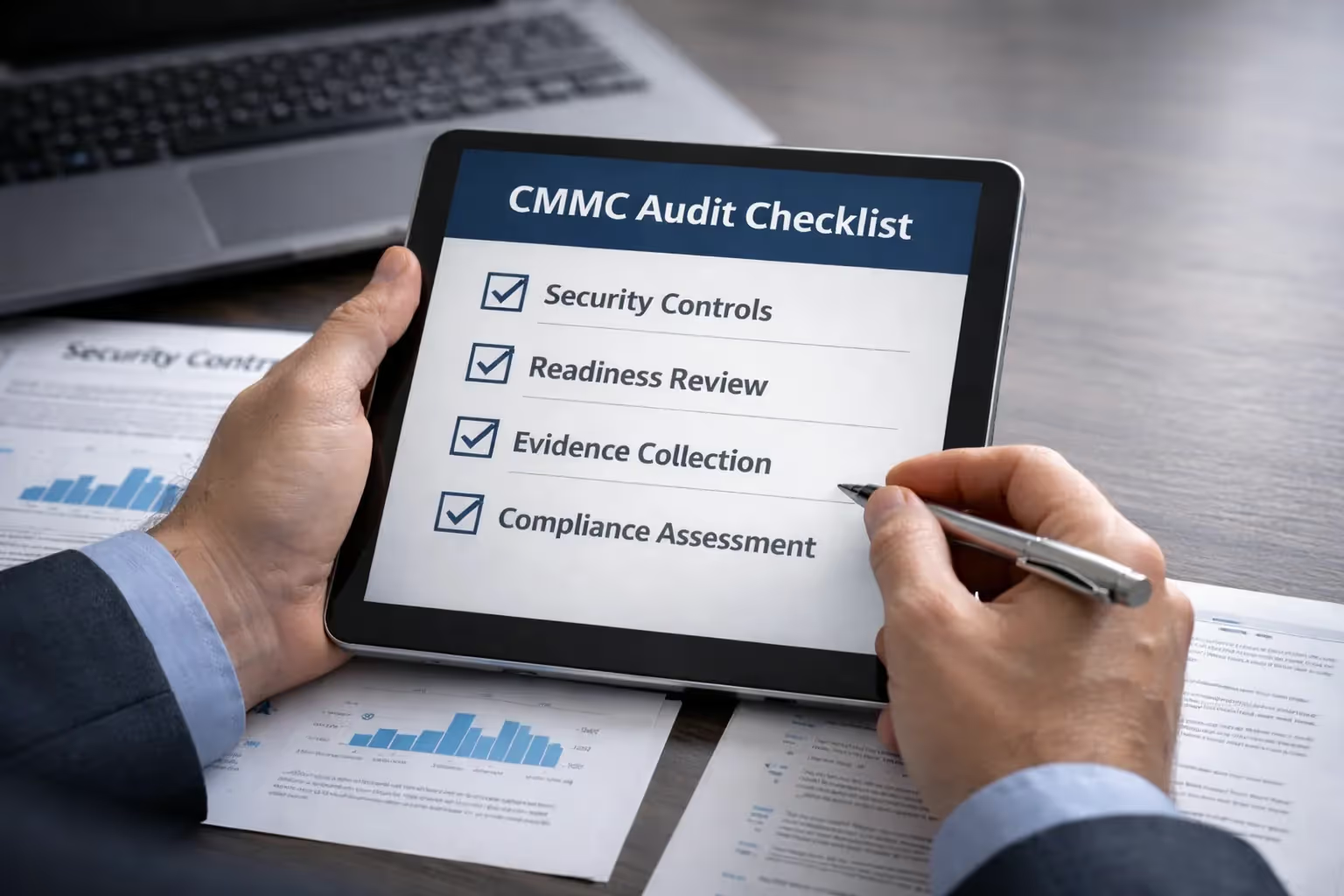
A successful audit is the result of disciplined, proactive preparation. This section serves asa practical guide to CMMC audit preparation, breaking the work down into logical phases. It is designed to be your master CMMC audit checklist.
Phase 1: Foundational Documentation
The bedrock of any audit is a set of clear, accurate, and up-to-date documents. Assessors will review this documentation before they even begin testing controls.
- The System Security Plan (SSP), often referred to as the system security plan in formal documentation, is the master document for your CMMC program and maps implemented safeguards to documented CMMC requirements.. It describes your in-scope environment and details how you meet each and every required CMMC control.
- The Plan of Action & Milestones (POA&M): This document lists any controls that are not yet fully implemented. It serves as your project plan for remediation, with assigned owners and target dates for each open item. 4]
- Policies and Procedures: Your program must be governed by a set of formal policies that state management's intent. These must be supported by detailed procedures that provide step-by-step instructions for your team to follow for key processes like incident response and change management.
Diagrams and Inventories: You must maintain current network and data flow diagrams, as well as inventories of all in-scope assets, software, and identities.
A Deeper Look into the SSP and POA&M
A common mistake is to create documentation that is too generic. Your SSP should not just state "Control AC.2.016 is met." It must provide a detailed narrative that explains how the control is implemented within your specific environment. For example, it should describe the tools you use (e.g., “Access is controlled via role-based access groups in Microsoft Entra ID (formerly Azure Active Directory)”), the processes you follow, and the people responsible. The SSP must be a living document, updated whenever there is a significant change to your systems or controls.
Read also: Preparing and Planning for CMMC Compliance Success
Similarly, a POA&M is not a sign of failure but a sign of a mature risk management process. A strong POA&M entry includes a specific description of the weakness, the associated CMMC control, a detailed remediation plan, the resources required to fix it, a realistic milestone date, and the name of the individual responsible for closure.
Phase 2: Implementing and Hardening Key Control Areas
With your documentation in place, the next phase is to ensure your technical controls are operating effectively. While all controls are important, assessors often focus on a few key areas that are common sources of findings.
- Access Control: Ensure user access rights are reviewed regularly and that the principle of least privilege is enforced. Pay special attention to service accounts, ensuring they have clear owners and limited permissions.
- Change Management: All changes to your in-scope environment, especially to network firewalls and cloud configurations, must go through a formal approval process that leaves a clear audit trail.
- Audit and Logging: Verify that your logs are capturing sufficient detail to investigate an incident and that they are retained for the required period. Sparse logs or short retention windows are a common finding.
- Backup and Recovery: Your backup processes must not only run successfully but must be tested regularly. You need to be able to prove, with records, that you can restore data and systems in a timely manner.
- Incident Response: Your incident response (IR) plan is only valuable if it is tested. Assessors will want to see more than just a document. They will look for evidence of tabletop exercises, which are guided discussions where your IR team walks through a simulated incident scenario, like a ransomware attack. The most important evidence from these drills is the "after-action report," which documents lessons learned and creates actionable tickets to implement improvements.
- Configuration Management: This involves establishing secure baselines for all your systems. A practical approach is to use an industry-standard benchmark, such as those from the Center for Internet Security (CIS) or the Defense Information Systems Agency (DISA STIGs), as your starting point. You must then use tools to perform configuration drift monitoring, which automatically detects and alerts when a system's configuration no longer matches the approved baseline.
Phase 3: The Internal Audit and Readiness Review
Before the formal CMMC audit, you must conduct a thorough internal audit. This is your "dress rehearsal."
- Simulate the Audit: Have an independent party perform a mock audit. They should sample controls, request evidence, and interview control owners, just as a real assessor would.
- Rehearse Demonstrations: Have your technical teams practice their live demonstrations for key processes like user onboarding/offboarding, change management, and incident response. This builds confidence and ensures the presentations are smooth and efficient.
- Brief Leadership: Provide your executive team with a clear, honest summary of your readiness status, including any remaining open items on your POA&M, your target dates, and any residual risks.
Phase 4: Curating and Organizing Audit Evidence
Auditors value proof of daily operation, not last-minute efforts. Your evidence must be authentic, dated, and easy to trace back to a specific control. There are three primary types of evidence an assessor will use to verify a control, and you should be prepared to provide all three. [2]
- Examine: This is the review of your documentation. The assessor will read your policies, procedures, SSP, and other administrative records to understand the design and intent of your controls.
- Interview: The assessor will speak directly with your personnel, such as system administrators, developers, and HR staff, to confirm that they understand and follow the documented procedures. This is where training and rehearsals pay off.
- Test: This is the most powerful form of evidence. The assessor will observe a control in action. This can be a live demonstration of a process (like revoking a user's access in real-time) or a review of technical outputs (like the results of a vulnerability scan or the logs from a firewall).
It is also critical to ensure "evidence freshness and sufficiency." An assessor needs to see that a control has been operating consistently over time. A single screenshot from six months ago is not sufficient proof. You should be prepared to provide evidence samples that are recent and cover a representative period, demonstrating that your security program is a continuous, operational reality.
Part 3: Navigating the Formal Assessment
With thorough preparation complete, you will be ready for the formal audit event.
What to Expect During the Assessment: Interviews, Demos, and Sampling
The formal CMMC audit process is an interactive and structured evaluation designed to verify that your security controls are implemented and operating as intended. The assessors will use the three methods, interviews, demonstrations, and sampling, to verify your controls. They will select a sample of systems, users, and changes and ask you to "show them the proof." For example, they may ask you to demonstrate the process for reporting a security incident, then ask to see the ticket and communication records from the last time a real incident occurred.
Managing the Visit and Handling Findings
Create a short schedule for the visit, with clear times, topics, and presenters. Maintain a calm, professional tempo, leaving space between sessions to pull evidence. If the assessors identify a finding or nonconformity, your job is to understand it, document it, and work with them to agree on a plan for corrective action. After the CMMC audit visit, you will receive a formal report. Address any open items with clear owners and dates, and provide the evidence of your fixes back to the assessment team.
Conclusion
A CMMC audit does not reward last-minute heroics. It rewards discipline, clarity, and proof of consistent operation. The process begins with a well-defined scope and a plan that maps your contracts to the required CMMC level. Long-term CMMC compliance success is achieved by building accurate records that match the reality of your live systems, fixing high-value gaps early, and rehearsing your processes. During the visit, a team that can show live systems, clean tickets, and trained staff who know their roles will inspire confidence. This guide provides the language, steps, and a foundational CMMC audit checklist to help you move with confidence from preparation to successful CMMC certification.
An experienced advisor can help your team move from intent to evidence
A guided readiness process can help you tailor your preparation to your specific level, scope, and timeline. A structured review can refine your control matrix and help you curate proof that stands up to an assessor's questions. Whether you need a focused tune-up or a full program build, a measurable plan is key to presenting a strong program on review day - and if you’re ready to take the next step, you can contact our team to discuss your CMMC audit readiness.
{{cta}}
References
- 32 CFR Part 170: Cybersecurity Maturity Model Certification (CMMC) Program (Electronic Code of Federal Regulations, eCFR) [1]
https://www.ecfr.gov/current/title-32/subtitle-A/chapter-I/subchapter-G/part-170
- U.S. Department of Defense Chief Information Officer (DoD CIO): CMMC Assessment Guide, Level 2, Version 2.13 (September 2024) (PDF) [2]
https://dodcio.defense.gov/Portals/0/Documents/CMMC/AssessmentGuideL2v2.pdf
- U.S. Department of Defense Chief Information Officer (DoD CIO): CMMC Assessment Guide, Level 3, Version 2.13 (September 2024) (PDF) [3]
https://dodcio.defense.gov/Portals/0/Documents/CMMC/AssessmentGuideL3v2.pdf - National Institute of Standards and Technology (NIST): NIST Special Publication 800-171 Revision 2, Protecting Controlled Unclassified Information in Nonfederal Systems and Organizations (PDF) [4] https://nvlpubs.nist.gov/nistpubs/SpecialPublications/NIST.SP.800-171r2.pdf


FAQ
What triggers a CMMC audit request?

The requirement for a CMMC audit is triggered by the language in a DoD contract. The contract will specify the CMMC level required for that particular effort, which in turn defines the assessment method (e.g., self-assessment or third-party).
Do we need to hire outside help for a CMMC audit?
Many teams use partners for readiness assessments, evidence curation, and rehearsal. External eyes can spot gaps early that your internal team might miss. However, the responsibility for operating the controls always remains with your organization.
What is the difference between a Level 1 and Level 2 audit?
The depth and breadth of the review are the main differences. A CMMC level 1 audit focuses on 15 basic controls for protecting FCI. A Level 2 audit is a much more comprehensive CMMC compliance audit that covers all 110 controls from NIST SP 800-171 required for protecting CUI.
What about a Level 3 audit?
A CMMC level 3 audit is even more rigorous. It is conducted by government assessors and includes advanced controls designed to protect against sophisticated cyber threats. This level is only required for a small number of high-priority DoD programs.
About the author
.avif)
Patrick Ibrahim
—
Senior Director, Compliance Services
With over a decade of experience in information security, working with hundreds of companies including fortune 50 organizations and startups alike, Patrick excels at all things compliance.
Patrick’s expertise spans ISO, PCI, HITRUST as well as CMMC in the Federal space, with hands-on experience conducting combined audits (PCI DSS, SOC 2, HITRUST). With a proven track record in BCPDR planning and realistic tabletop testing, Patrick is passionate about delivering actionable strategies that not only secure data but also ensure business continuity during disruptions.