How Much Does FedRAMP Certification Cost? Official Figures, Classes and Annual Obligations
Published on
March 13, 2026
/
updated on
October 21, 2026
What FedRAMP certification costs under the 2026 rules: GAO's 2020 to 2022 estimates, 4 certification classes, the budget lines, and yearly obligations.
FedRAMP certification has no official price. When an agency or prime contractor asks whether your product is FedRAMP certified, leadership wants to know: how much does FedRAMP certification cost? Providers and assessors need not report to FedRAMP what an assessment cost "at this time" (1). The only published government figures are GAO's estimates for 2020 to 2022, which "ranged anywhere from tens of thousands to millions of dollars" across agencies and providers (2).
This guide is for engineering and security leaders at SaaS companies and other cloud service providers who need a realistic cost for selling to the federal government. A lower class costs less, and so does 20x instead of Rev5 for a service on certified infrastructure (3, 4).
The Cost of FedRAMP Certification: What the Official Data Shows
The closest thing to an official total cost is a set of GAO estimates for 2020 to 2022, collected before FedRAMP 20x and the 2026 rules existed (2).
What GAO measured for 2020 to 2022
GAO-24-106591, released on 18 January 2024, is the cost review the FedRAMP Authorization Act ordered (5). GAO sent a structured questionnaire to six agencies and 13 providers, and the costs it received were estimates made by varying methods (2). Eight providers, three of them small businesses, reported about $12.4 million in total, from $300,000 to $3.7 million each (2). In GAO's word these are FedRAMP authorization costs; FedRAMP now calls the result a certification (6).
The provider figures also cover different things (2):
- The assessor: every provider that reported counted it.
- Labor and contractor support: four providers left it out.
- Infrastructure updates: three providers, two of them small businesses, included them.
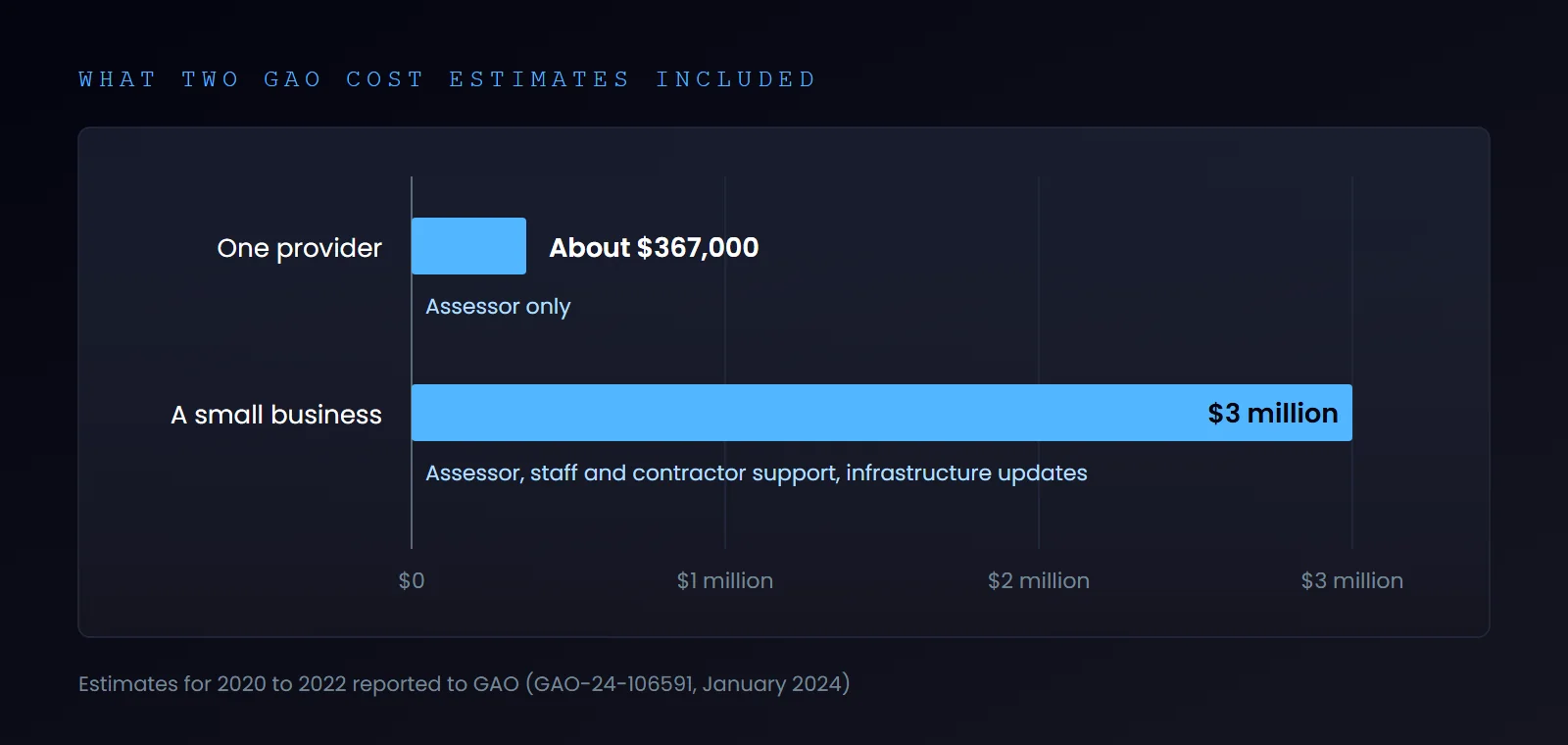
Two of GAO's examples show the spread. One provider reported about $367,000, and that was its assessor alone; a small business reported $3 million, which added its own staff and contractor support and its infrastructure updates to the assessor (2).
Five of the six agencies also estimated what sponsoring a service cost them, nearly all between $69,000 and $400,000 (2).
Table 1. GAO's cost estimates for FedRAMP, 2020 to 2022
| Who reported | Estimated cost | What the estimates counted |
|---|---|---|
| 8 of the 13 selected providers, including 3 small businesses | $300,000 to $3.7 million each; about $12.4 million in total | The assessor in every case; labor and contractor support in some; infrastructure updates in three |
| 5 of 6 selected agencies, sponsoring 59 services | Nearly all $69,000 to $400,000; a few as low as $12,000; one at $706,000 | Generally: reviewing the provider's security documentation, working with the provider, and issuing the agency's authorization; two agencies also counted authorizing their own systems |
Source: GAO-24-106591 (2); read October 2026.
Why no newer official figure exists
FedRAMP proposed collecting these numbers and then dropped the idea. RFC-0019, opened on 13 January 2026, would have required providers to report their assessment costs with an attestation signed by the assessor (7). NTC-0002 of 18 February 2026 withdrew it: cloud providers and assessment services "will not be required to report information to FedRAMP regarding the expenses incurred for any assessment at this time" (1).
The grounds for dropping the idea apply to any average you read:
- A private contract: assessment costs are paid by cloud service providers "as part of a commercial agreement with an assessment organization that does not involve the government" (1).
- No common scope: commenters told FedRAMP that one provider's cost reflects its own scope and complexity, and that these costs "could not and should not be compared across providers" (1).
The law has the General Services Administration (GSA), where FedRAMP is established, review the costs of independent assessment services regularly (8); for that review, FedRAMP can now rely only on "limited publicly available information" (1).
FedRAMP Cost by Certification Type and Class
Cost follows two choices: the certification type, 20x or Rev5, and the class, A to D (3, 4). A certification shows that adequate security materials exist for an agency's own Authorization to Operate (ATO) decision, and FedRAMP grants no ATOs (9). The ultimate guide to FedRAMP explains how the program works.
20x vs Rev5 cost
The two types differ on cost (4):
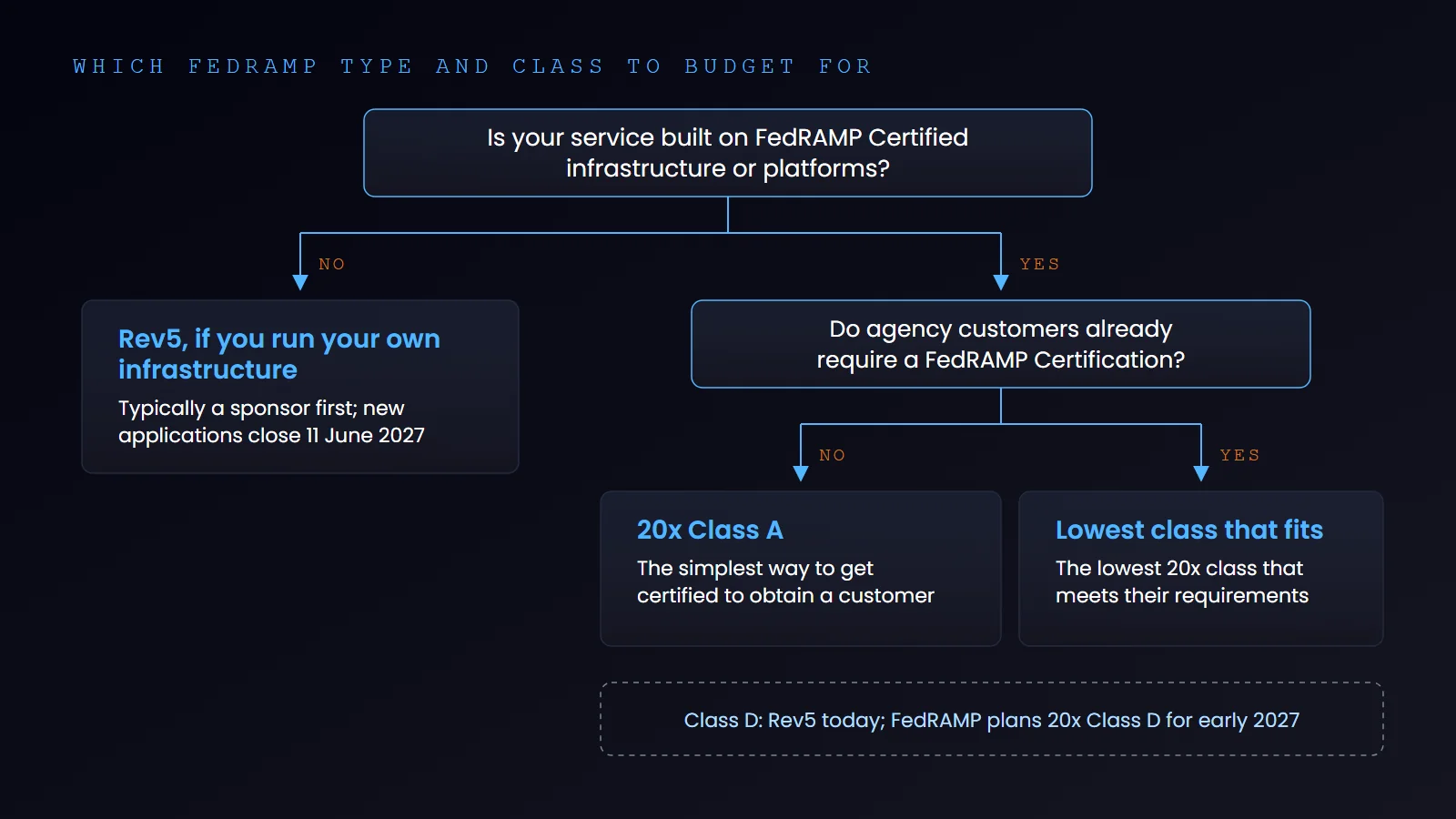
- 20x: for cloud service offerings built on FedRAMP Certified infrastructure or platforms, FedRAMP calls it "the fastest, cheapest, and best way" into the federal market, with no agency contract or sponsor needed.
- Rev5: it "requires significant additional investment in time and effort compared to FedRAMP 20x", but it is currently the only option for a Class D service or one that runs its own infrastructure. It typically needs an agency sponsor in advance.
FedRAMP will stop accepting applications for new Rev5 certifications on 11 June 2027 (10), and on 8 October 2026 it told providers that have not already made significant Rev5 progress with a guaranteed sponsor to "pivot to FedRAMP 20x immediately" (11). A 20x Class D pilot is planned for late 2026, with formal availability in early 2027 (4).
Cost by certification class
In the agency guidance, "services with a lower Certification Class will be cheaper to procure and operate", while higher classes cost more and give agencies more assurance (3). Classes are meant to be taken one after another, so "your investment can scale with agency interest and resource availability" (12). Many providers with strong security programs stop at Class A or B "to keep government pricing aligned with commercial pricing" (3).
A class is not an impact level: FedRAMP tells agencies not to read classes as one-for-one replacements for the old levels, and presumes Class C adequate for most Low or Moderate systems (3). For Rev5, its transition notice announced that Class C would include the former FedRAMP Moderate baseline (13). Our guide FedRAMP levels explained covers the legacy levels.
On FedRAMP's relative cost scale, shown in dollar-sign icons without dollar amounts, Class C gets three icons and Class D five (12).
Table 2. FedRAMP certification classes and what drives their cost
| Class | Relative cost scale (12) | Presumed adequate for (3) | Independent assessor (14, 15) | Available as (16) |
|---|---|---|---|---|
| A | 1 of 5 | Pilots, configuration and testing, or extremely low-risk use | Not required | 20x, Program path |
| B | 2 of 5 | Most Low impact systems; some Moderate or High with compensating controls | Required | 20x, Program path; Rev5, mostly Agency path |
| C | 3 of 5 | Most Low or Moderate systems; some High with compensating controls | Required | 20x, Program path; Rev5, mostly Agency path |
| D | 5 of 5 | Most agency systems, regardless of impact level | Required | Rev5, Agency path; 20x planned for 2027 |
Sources: as numbered in each column; read October 2026.
Where your service runs and what your agency customers require decide the type and class (4, 12).
Program vs Agency path cost
The path follows from the type. FedRAMP reviews the service itself on the Program path, mostly used for 20x; an agency authorizes and sponsors it first on the Agency path, which only Rev5 uses (16).
How much does the FedRAMP authorization process cost each side?
- The provider pays its assessor under a commercial agreement with the assessment organization (1).
- The agency, on the Agency path, invests "the resources up front", and a full traditional Rev5 security assessment review is "expensive and time consuming for the government" (17). Providers told GAO that agencies did not want to sponsor because of the cost of extra staff or contractors (2).
Two temporary Rev5 Program pipelines, Lost Sponsor and Ready Conversion, take Class B or C applications without an agency sponsor until 11 June 2027 (16). Only providers that lost a sponsor or completed a FedRAMP Ready assessment between January 2025 and March 2026 qualify.
FedRAMP cost for a SaaS company
To keep the cost to achieve FedRAMP certification for SaaS low, start at Class A, the recommended entry point "in most situations" (12).
- Designed for SOC 2 holders: Class A is built "for existing commercial products that already have a SOC 2 Type II certification and a mature security program" (12).
- No customer needed yet: for a SaaS startup without agency customers, it is "the simplest way to get FedRAMP Certified to obtain a customer" (12).
- No assessor required: a Class A certification can skip the independent assessor (15).
FedRAMP's compliance requirements still come on top of SOC 2 and any other security frameworks you hold. In 20x Phase 1, "No participants actively reused existing framework assessments such as SOC 2" (18). If you are still working on that report, start with our SOC 2 guide for SaaS companies.
Where the Money Goes in a FedRAMP Budget
Among the most expensive parts of FedRAMP compliance is the Security Decision Record, which "will take the most time and investment" of the package work (19). Eight of the 13 providers GAO surveyed called the changes their services needed to meet FedRAMP's requirements "costly and time consuming" (2). Table 3 gives the cost breakdown by who is paid.
Table 3. FedRAMP budget lines and who is paid
| Budget line | Who is paid | Needed for |
|---|---|---|
| Advisory and readiness work | An advisory firm, if you hire one | Optional at every class (20) |
| Engineering and remediation | Your engineers and contractors | Every certification (15) |
| Certification package | Your own team | Every certification (15) |
| Independent assessment | A FedRAMP Recognized assessor | Classes B, C, and D (14) |
| Internal team time | Your own staff | Every certification (15) |
Sources: as numbered in each row; read October 2026.
Advisory and readiness work
FedRAMP does not provide "tools, guidance, advice, or support" for the implementation phase; it leaves that help to private companies (19). Its advice to newcomers is that providers new to FedRAMP "will almost always benefit from using a high quality FedRAMP Advisory Service" (20). Advisory is a separate engagement from the assessment, and a firm that offers both must say at all times which capacity it is acting in (21). Each advisory firm sets its consulting fees for this readiness work in its own proposal.
Engineering and remediation
This is where you change a commercial service to meet federal requirements. The work covers "hundreds of FedRAMP rules that you will need to address and many of them will require organizational change" (19). In GAO's sample, two providers had to change their encryption to meet FIPS 140-3, and four had to duplicate capabilities such as vulnerability management inside the environment they ran for federal agencies (2). Remediation stays on the budget until the gaps close.
The certification package
For Rev5, the Certification Package Overview "replaces the historically required System Security Plan (not including appendices)" (22). The larger piece is the Security Decision Record, which collects how you have decided to approach the remaining FedRAMP rules (19). Your own team writes this FedRAMP documentation, and a good advisor guides and reviews it. An advisor who claims to produce the artifacts and meet ongoing requirements for you "is misrepresenting the spirit and intent of a FedRAMP Certification", in FedRAMP's words (20).
The independent assessment
A FedRAMP Recognized independent assessment service is mandatory for Classes B, C, and D, and a Class A certification can skip it (14, 15). The provider pays for the initial FedRAMP assessment, and every later one, under a commercial agreement that does not involve the government (1). Assessors must be accredited by A2LA to be recognized by FedRAMP (23). For this service, FedRAMP has retired the term "3PAO" (24). As of 13 October 2026, the FedRAMP Marketplace listed 49 assessors (25). GAO's one assessor-only figure is in Figure 1.
Hidden Costs a FedRAMP Quote Leaves Out
An assessor's or an advisor's quote covers its own fee, and the FedRAMP costs below sit outside it; GAO's survey shows how differently providers counted the first two (2):
- Your own team's time: labor and contractor support, which four of GAO's providers left out of their figures. Count the hours of your compliance personnel and engineers yourself.
- Infrastructure updates: the cost of updating infrastructure to meet FedRAMP requirements, which three of GAO's providers counted. Price the architecture changes as a line of their own, apart from any fee.
- Re-engineering a commercial service: new encryption, or a second copy of a capability such as vulnerability management for federal customers. It belongs on the engineering line of Table 3.
- Replacing uncertified dependencies: swapping out a third-party service that is not FedRAMP Certified adds implementation costs outside the assessor's fee.
- A poor assessor choice: the wrong assessor "can lead to significant delays, increased costs, and frustration" (14). Delays add staff time and remediation efforts to the other lines.
On the Agency path, the sponsoring agency carries its own review cost (17), so that line is not yours to budget.
What Moves a FedRAMP Budget Up or Down
Once the type and class are set, your compliance costs depend on how much of the work is left. The time to complete implementation and apply "varies wildly" with factors that include these five (15):
- Engineering resources for GRC work: engineers who can support compliance keep the effort down. The factor is the "Availability of engineering resources to support Governance, Risk, and Compliance (GRC) engineering functions". Leaving a compliance group without that access "is a guaranteed way to make obtaining and maintaining FedRAMP Certification far harder and less efficient than it should be".
- Infrastructure complexity: the "Complexity of the underlying infrastructure and information systems" sets how much work each rule takes. Draw your boundary tightly around the cloud systems that handle agencies' sensitive data, so it holds no more system complexity than the certification needs.
- Program maturity: the "Maturity of the existing engineering and information security programs" decides how many FedRAMP requirements you meet on day one. Security controls you already run with evidence behind them only need documenting.
- Third-party services: each dependency that is not FedRAMP Certified adds work on your side, and "Reliance on third-party infrastructure or platform services that aren't FedRAMP Certified" is one of the factors.
- Executive support: achieving FedRAMP compliance changes how teams work, and certification "is not simply writing about everything that already exists". FedRAMP lists "Executive support, especially within engineering and security functions" as a factor of its own.
What It Costs to Maintain FedRAMP Certification Each Year
After the initial costs, your annual costs come from what the 2026 rules require of your class; FedRAMP publishes no annual figure (1, 26).
What the 2026 rules require by class
A 20x Class A provider must keep meeting its underlying security framework (26), such as the SOC 2 Type II that Class A is designed around (12).
The Collaborative Continuous Monitoring ruleset adds an Ongoing Certification Report "every 3 months" from Class B upward, and its contents include accepted vulnerabilities and reportable security incidents (27).
Table 4. Recurring FedRAMP obligations by certification class
| Obligation | Class A | Class B | Class C | Class D |
|---|---|---|---|---|
| Independent assessment, at least once a year (26) | MAY | MUST | MUST | MUST |
| Ongoing Certification Report, every 3 months (27) | Not listed | MUST | MUST | MUST |
| Quarterly Review, every 3 months (27) | MAY | SHOULD | MUST | MUST |
| Vulnerability detection frequency on resources likely to drift (SHOULD) (28) | Every 3 months | Every month | Every 14 days | Every 7 days |
Sources: as numbered in each row; read October 2026.
Agencies now own Plans of Action and Milestones (POA&Ms) and should not expect providers to convert their vulnerability lists into them (29). The monthly continuous monitoring templates stay on the legacy page "for reference only" (30). Price your ongoing continuous monitoring costs row by row from Table 4, including the vulnerability assessments behind each report.
When the new rules apply
The Consolidated Rules for 2026 take mandatory effect on 1 January 2027, "subject to specific overall applicability and effective dates within certain areas" (10). Any provider may adopt the continuous monitoring rules early, from 4 July 2026 (27). For a 2026 budget, the dates differ by type and by Table 4 row:
- Every provider: the vulnerability detection row applies from 7 December 2026, with a grace period to 7 March 2027, under CISA Binding Operational Directive 26-04 (28).
- 20x, obtaining a certification: the independent assessment, report, and review rows apply from 4 July 2026 (26, 27).
- 20x, maintaining a certification: the independent assessment, report, and review rows apply from 1 January 2027, with a grace period that ends at the first independent assessment started after that date (26, 27).
- Rev5, obtaining a certification: the independent assessment, report, and review rows apply from 1 January 2027; the grace period ends at the first independent assessment started after that date for the assessment (26) and on 1 October 2027 for the reports and reviews (27).
- Rev5, maintaining FedRAMP compliance: the annual assessment applies from 1 January 2027 (26), and the reports and reviews from 2 April 2027, with the grace period ending on 1 October 2027 (27).
How to Reduce the Cost of a FedRAMP Certification
Six choices reduce costs before any proposal arrives.
Start at the lowest class that fits
If you have agency customers that require a certification, FedRAMP's guidance is to "Invest in the lowest starting class that meets the agency requirements and your business fit"; without them, Class A is the simplest start (12). Do not go straight to Class C or D unless an agency contract requires that commitment.
Choose 20x when your platform qualifies
If your service is built on FedRAMP Certified infrastructure or platforms, 20x is the cheapest way into the federal market, with no sponsor to find (4). Check that condition before you request any Rev5 proposal.
Build on FedRAMP Certified infrastructure
When you choose cloud services or replace a component, pick ones that are already FedRAMP Certified, and ask each vendor to show its certification. An uncertified dependency is one of the factors that slow implementation (15).
Stay on Rev5 only with significant progress and a guaranteed sponsor
New Rev5 applications close on 11 June 2027 (10). Without both conditions, FedRAMP's 8 October 2026 advice is to pivot to 20x (11). Check both conditions against your own status before you fund more Rev5 package work.
Get two or three assessor proposals
Get proposals from at least two or three FedRAMP Recognized assessors and compare their pricing (14). Ask each one to price the same boundary, type, and class, with the initial assessment and the annual assessments priced separately, so you compare like with like.
Check an advisor against FedRAMP's red flags
An offer to help "obtain a FedRAMP Authorization", or talk of impact levels, is "an immediate warning", because FedRAMP no longer uses that terminology (20). Ask the advisor what its gap assessments cover, who writes each document, and in which capacity the firm acts if it also assesses (21).
How Long FedRAMP Certification Takes
FedRAMP sets a target for its own review and a deadline for starting an assessment, but no timeline for the whole certification process. The time to complete implementation and apply "varies wildly" with factors such as engineering resources and program maturity (15). Plan around these points:
- FedRAMP's review: the program aims to make an initial decision within 30 days of an application, a goal it set again for fiscal year 2027 (31, 11). There is no SLA, and the clock stops while FedRAMP waits on you. Before FedRAMP set this goal, a review "could take a year or more" (31).
- The listing commitment: a FedRAMP Marketplace listing commits you to begin an assessment within two years, and FedRAMP expects that with 20x "you should be able to qualify for a FedRAMP Class B Certification within a few months" (32).
- Waiting on others: in the FedRAMP process before 2026, receiving timely responses from stakeholders was among the challenges GAO's agencies and providers reported most often (2).
Is FedRAMP Certification Worth the Cost?
FedRAMP certification is worth the cost when agency demand already exists. The guidance on classes ties each step up to that demand: "Invest in a higher class based on what your agency customers need and are willing to pay for" (12). Two facts help you size that demand:
- Reuse: a certification supplies the security materials an agency uses in its own ATO decision (9), and OMB memo M-24-15 of July 2024 notes that agencies "have reused existing authorizations hundreds of times across over 300 offerings" (33).
- The size of the market: FedRAMP ended fiscal year 2026 with 538 certified cloud service offerings and recorded 760 new agency ATOs or authorizations to use (ATUs) that year (11).
If you cannot yet name the federal contracts a certification would qualify you for, or many federal agencies asking for your product, start with Class A and hold the significant investment of a higher class until an agency asks for it. When you move up from Class A, you will need an assessor (14, 15).
Scope Your FedRAMP Budget with CyberCrest
Your number comes from your boundary, type, and class, and from the proposals you collect. In one call, with nothing committed, we review your target path and class and how much of the work you have already done. Our FedRAMP Compliance Services cover four pieces:
- FedRAMP Gap Assessment: we assess your platform against the rules for your class and order the gaps.
- Remediation Guidance and Review: we set out what each requirement needs and review your team's fixes.
- Submission Preparation: we review your package before it goes in.
- Ongoing Compliance Support: we review the evidence behind each recurring report.
We act as your advisor; a separate FedRAMP Recognized independent assessment service performs the assessment. Talk to us about scoping yours.
Sources
- FedRAMP, NTC-0002 Outcome from RFC-0019 Reporting Assessment Costs, 18 February 2026. https://www.fedramp.gov/notices/0002/
- U.S. Government Accountability Office, Cloud Security: Federal Authorization Program Usage Increasing, but Challenges Need to Be Fully Addressed (GAO-24-106591), January 2024. https://www.gao.gov/assets/gao-24-106591.pdf
- FedRAMP, FedRAMP Certification Classes (agency guidance). https://www.fedramp.gov/2026/agencies/use/classes/
- FedRAMP, Choosing a Certification Type. https://www.fedramp.gov/2026/providers/start/type/
- FedRAMP, FedRAMP Authorization Act on Reports to Congress (44 U.S.C. § 3615). https://www.fedramp.gov/2026/authority/law/reports/
- FedRAMP Marketplace, Advisors (terminology notice). https://www.fedramp.gov/marketplace/advisors/
- FedRAMP, RFC-0019 Reporting Assessment Costs. https://www.fedramp.gov/rfcs/0019/
- FedRAMP, FedRAMP Authorization Act on GSA (44 U.S.C. § 3608 and § 3609). https://www.fedramp.gov/2026/authority/law/gsa/
- FedRAMP, FedRAMP Marketplace Quick Start Guide. https://www.fedramp.gov/marketplace/guide/
- FedRAMP, Important Dates for the Consolidated Rules for 2026. https://www.fedramp.gov/2026/timeline/
- FedRAMP, From Foundation to Implementation: Scaling a Better Path to Cloud Security, 8 October 2026. https://www.fedramp.gov/2026-10-08-from-foundation-to-implementation/
- FedRAMP, Choosing a Certification Class. https://www.fedramp.gov/2026/providers/start/class/
- FedRAMP, NTC-0004 Initial Outcome from RFC-0020 FedRAMP Authorization Designations. https://www.fedramp.gov/notices/0004/
- FedRAMP, Finding an Assessor. https://www.fedramp.gov/2026/providers/implement/assessor/
- FedRAMP, The Initial Implementation Phase. https://www.fedramp.gov/2026/providers/implement/
- FedRAMP, Choosing a Certification Path. https://www.fedramp.gov/2026/providers/start/path/
- FedRAMP, NTC-0008 Initial Outcome from RFC-0023 Rev5 Program Certifications. https://www.fedramp.gov/notices/0008/
- FedRAMP, FedRAMP 20x. https://www.fedramp.gov/20x/
- FedRAMP, Do the Work. https://www.fedramp.gov/2026/providers/implement/work/
- FedRAMP, Finding an Advisor. https://www.fedramp.gov/2026/providers/start/advisor/
- FedRAMP, Advisory Services. https://www.fedramp.gov/2026/advisors/
- FedRAMP, Certification Package Overview ruleset (Consolidated Rules for 2026). https://www.fedramp.gov/2026/reference/certification-package-overview/
- A2LA, FedRAMP Third-Party Assessment Organizations (3PAO) program. https://a2la.org/accreditation/fedramp/
- FedRAMP, FedRAMP Definitions (Consolidated Rules for 2026). https://www.fedramp.gov/2026/definitions/
- FedRAMP Marketplace, Assessors. https://www.fedramp.gov/marketplace/assessors/
- FedRAMP, Independent Verification and Validation ruleset (Consolidated Rules for 2026). https://www.fedramp.gov/2026/reference/independent-verification-and-validation/
- FedRAMP, Collaborative Continuous Monitoring ruleset (Consolidated Rules for 2026). https://www.fedramp.gov/2026/reference/collaborative-continuous-monitoring/
- FedRAMP, Vulnerability Detection and Response ruleset (Consolidated Rules for 2026). https://www.fedramp.gov/2026/reference/vulnerability-detection-and-response/
- FedRAMP, Agency Plans of Action and Milestones. https://www.fedramp.gov/2026/agencies/use/ongoing/poams/
- FedRAMP, FedRAMP Legacy Documentation. https://www.fedramp.gov/legacy/
- FedRAMP, Getting Certified. https://www.fedramp.gov/2026/providers/implement/get-certified/
- FedRAMP, Getting Listed. https://www.fedramp.gov/2026/providers/implement/marketplace/
- Office of Management and Budget, Memorandum M-24-15, Modernizing the Federal Risk and Authorization Management Program, 25 July 2024. https://www.whitehouse.gov/wp-content/uploads/2024/07/M-24-15-Modernizing-the-Federal-Risk-and-Authorization-Management-Program.pdf








FAQ
How much does it cost to get FedRAMP certified?

There is no official price. GAO's estimates for 2020 to 2022 put eight providers at $300,000 to $3.7 million each (2). Those figures counted different things: one only its assessor, another its own staff and infrastructure too. Your own number depends on your class, your type, and how much work your boundary still needs.
Why is FedRAMP so expensive?
Certification changes how you build and run the service. In FedRAMP's words, certification "is not simply writing about everything that already exists" (15) and involves "hundreds of FedRAMP rules", many needing organizational change (19). Eight of the 13 providers GAO surveyed called the changes "costly and time consuming", and two had to rework their encryption to meet FIPS 140-3 (2).
How much do FedRAMP compliance consulting services cost?
FedRAMP publishes no consulting cost; each advisory firm sets it in its own proposal. The program leaves implementation help to private companies (19), lists advisors on its Marketplace "without formal quality review" (20), and treats advisory as a separate service from the assessment (21). Compare what each proposal covers, from the readiness assessment cost to any gap analysis and document reviews.
What's a realistic budget range for hiring a FedRAMP 3PAO in 2026?
No official range exists for the assessor fee: providers and assessors are not required to report what assessments cost "at this time" (1). The only government example comes from GAO's 2020 to 2022 data, where one provider reported about $367,000 for its assessor alone (2). Get proposals from at least two or three FedRAMP Recognized assessors and compare their pricing (14).
Can small cloud companies afford FedRAMP or is it only realistic for well-funded enterprises?
Small companies can start at the lowest class. FedRAMP designed its classes to be taken progressively, so "your investment can scale with agency interest and resource availability" (12). Three of the eight providers reporting costs to GAO were small businesses. One of them reported $3 million, which added its own staff and contractor support and its infrastructure updates to the assessor (2). Affordability depends on the class your customers need.
How do I choose between pursuing agency ATO vs JAB authorization?
That choice no longer exists. The Joint Authorization Board (JAB) provisional ATO belonged to "the prior FedRAMP policy structure", and OMB's M-24-15 ordered existing JAB P-ATOs re-designated (33). The 2026 rules have two paths: an agency sponsors a Rev5 service first on the Agency path, and FedRAMP reviews the service with no sponsor on the Program path (16). FedRAMP advises any provider that has not already made significant Rev5 progress with a guaranteed sponsor to pivot to 20x (11).
About the author
.avif)
Ron Gupta
—
Senior Director: Governance, Risk and Compliance
Getting his start in tech as an analyst and founder at Via Digital ID, Ron brings to the table a unique approach to cyber security. With over a decade of experience in GRC, Ron has developed and honed a skillset rich in combined audit and assessment as well as risk management and mitigation.
Ron’s ability to convey critical information, results and plans of action to executive leadership is a key skill that allows him to propel the clients he engages with to success. Ron is adept at taking target frameworks, implementing them within environments while reducing overall risk to organizations.