ISO 9001:2026 Guide: Key Changes and Transition Deadlines
Published on
October 23, 2026
The Global ACI transition dates to 30 September 2029, the clause changes against ISO 9001:2015, and 5 steps to prepare your quality system.
ISO published ISO 9001:2026, the sixth edition of its quality management standard, on 16 September 2026, and it replaces ISO 9001:2015. Accredited 2015 certificates that are not transitioned to the new edition remain valid until 30 September 2029 at the latest.
If you manage quality at a manufacturer, services firm, or government supplier, the new edition may reach you through a customer or your certification body. Management will then ask what changed and whether the certificate is at risk. Until September 2026 the standard existed only as drafts, so older change lists and dates were forecasts. This guide gives you the dated deadlines from the official transition rules, the changes that matter for an existing system, and the steps before each date, so you can tell management where the certificate stands.
Key Takeaways
- The sixth edition is published. ISO released ISO 9001:2026 on 16 September 2026 as the current edition of its quality management standard, for organizations of any size or sector. The new edition replaces ISO 9001:2015.
- 2015 certificates stay valid for now. The ISO 9001:2015 standard is withdrawn, but accredited 2015 certificates remain valid until 30 September 2029 at the latest, within their own certification cycle. They move over at a scheduled or special transition audit.
- New 2015 certificates stop on 31 March 2028. After that date, certification bodies issue new and initial certifications only to ISO 9001:2026, and they are told to plan initial stage 1 and stage 2 audits with that date in mind.
- The headline changes are limited. They include quality culture and separate actions on opportunities, two of the changes to ISO 9001 in 2026 that the Foreword lists. Global ACI, the accreditation organization behind the transition rules, calls the overall changes "minimal."
What Is ISO 9001 Version 2026?
ISO 9001:2026, the current version of ISO 9001 as of 2026, is the sixth edition of Quality management systems: Requirements and replaced ISO 9001:2015. On the official ISO 9001:2026 page, the ISO 9001:2026 publication date is 16 September 2026 and the stage is 60.60, "International Standard published." The text runs to 36 pages and was developed by subcommittee ISO/TC 176/SC 2.
Is certification to the ISO 9001 new version mandatory? No: certification is voluntary, and ISO 9001 remains the only standard in the ISO 9000 family that an organization can be certified to. ISO says any organization can use it, whatever its size, sector, or activities. You can implement the standard without a certificate; certification is a way to show conformity to external parties, such as customers.
ISO 9001 Latest Version: Is ISO 9001:2015 Still Valid?
Accredited ISO 9001:2015 certificates stay valid until 30 September 2029 at the latest, within their own certification cycle. The standard itself is withdrawn: the ISO 9001:2015 standard listing says the 2015 edition "is no longer the current edition of the standard." ISO 9001:2026 replaced it and is the latest version of ISO 9001 as of 2026. Your certificate is not withdrawn with the standard.
Table 1 sets out what each document means for a certificate: the ISO 9001 latest edition (ISO 9001:2026), ISO 9001:2015, and the 2024 amendment to ISO 9001:2015.
Table 1. ISO 9001:2026 revision status and what it means
| Document | Status | What it means for a certificate |
|---|---|---|
| ISO 9001:2026 | Published; sixth and current edition | You can get an accredited certificate to it once your certification body's accreditation has transitioned |
| ISO 9001:2015 | Withdrawn | Accredited certificates stay valid within their own cycle, until 30 September 2029 at the latest |
| ISO 9001:2015/Amd 1:2024 | Withdrawn; incorporated into the 2026 edition | Its climate change consideration carries forward into the 2026 edition |
Sources: ISO standard pages (1, 2, 3); ISO 9001:2026 Foreword (4); Global ACI-TECH-3-TR 2029-09-30 (M) (5); What businesses need to know (6); read October 2026.
Plan new documents and gap assessments against the 2026 edition. A 2015 certificate whose printed cycle runs past 30 September 2029 does not have to be reissued with an earlier expiry date, but Global ACI lets your certification body change the expiry date "to reduce marketplace confusion." ISO 9001:2026 takes its vocabulary from ISO 9000, and ISO 9000:2026, Fundamentals and vocabulary, was published on 27 May 2026 as its fifth edition.
ISO 9001 Update in 2026: Transition Period and Deadlines
The ISO 9001:2026 transition period lasts three years and ends on 30 September 2029. The dates come from Global ACI-TECH-3-TR 2029-09-30 (M), a transition document that is mandatory for Global ACI's signatory accreditation bodies and the certification bodies they accredit. ISO also gives certified organizations three years.
The dates that matter depend on where you stand. If you hold a 2015 certificate, you choose when to transition, in a plan agreed with your certification body and by 30 September 2029; if you are working toward certification or new to ISO 9001, you choose which edition to certify to, a choice that ends on 31 March 2028.
The Global ACI Transition Timeline, Date by Date
As the About Global ACI page records, Global ACI was launched on 1 January 2026 and now covers the activities of the International Accreditation Forum (IAF) and the International Laboratory Accreditation Cooperation (ILAC). Its transition document sets five dates for accreditation bodies, certification bodies and certified organizations:
Table 2. Global ACI transition milestones for ISO 9001:2026
| Deadline | Who acts | What has to be done |
|---|---|---|
| 31 March 2027 | Accreditation bodies | Be ready to assess to ISO 9001:2026 and announce their transition process |
| 30 June 2027 | Certification bodies | Submit their transition declaration to their accreditation body |
| 30 September 2027 | Accreditation bodies | Complete their transition decisions on the certification bodies they accredit |
| 31 March 2028 | Certification bodies | Issue new and initial certifications only to ISO 9001:2026 |
| 30 September 2029 | Certification bodies and certified organizations | Complete the transition of certified clients, with the 2026 certificate issued; accredited 2015 certifications are no longer valid after this date |
Source: Global ACI-TECH-3-TR 2029-09-30 (M), sections 4 and 5 (5); read October 2026.
If you plan a first audit, note that no new ISO 9001:2015 certifications can be issued after 31 March 2028. Global ACI tells certification bodies to plan stage 1 and stage 2 audits with that date in mind. Figure 1 shows how three windows overlap: new 2015 certificates, new 2026 certificates and the transition of certified organizations.

Transition Audits: Timing, Scope, and Audit Time
Your certification body runs the transition audit as part of a surveillance or recertification audit, or as a separate special audit. Global ACI sets what that audit must review, at a minimum:
- the changed requirements of ISO 9001:2026 compared with the 2015 edition;
- changes to your organization's context;
- the need for any other changes to your management system.
The certification body may run the transition audit remotely if it ensures and can demonstrate that the audit objectives are met. It also decides whether the audit needs extra time, considering at least the degree of change to your system and whether the transition audit is combined with an annual audit. Global ACI adds: "Additional time may not be needed for a full system audit", that is, an audit that already covers your whole management system.
Certificates That Are Not Transitioned
If you decide not to transition, your certification body may keep auditing you against ISO 9001:2015, but it must tell you that the certification will expire when the transition period ends. That applies even when the printed cycle runs past 30 September 2029: in Global ACI's words, the certification "may not remain valid for the entire certification cycle." The risk can also sit with the certification body. One that decides not to transition must tell its affected clients in writing by 30 June 2027, and its accreditation for ISO 9001 is withdrawn at the end of the transition.
First Certification During the Transition: ISO 9001:2015 or 2026
You can get an accredited ISO 9001:2026 certificate only after your certification body's own accreditation has transitioned, and accreditation bodies have until 30 September 2027 to complete those decisions. A 2015 certificate issued in 2027, before the 31 March 2028 cut-off, stays valid only until 30 September 2029 unless you transition it.
Before you book a stage 1 audit, ask your certification body when it can audit to ISO 9001:2026. CyberCrest's guide on how to get ISO 9001 certification walks through the steps of a first certificate.
ISO 9001 Revision in 2026: Timeline from Draft to Publication
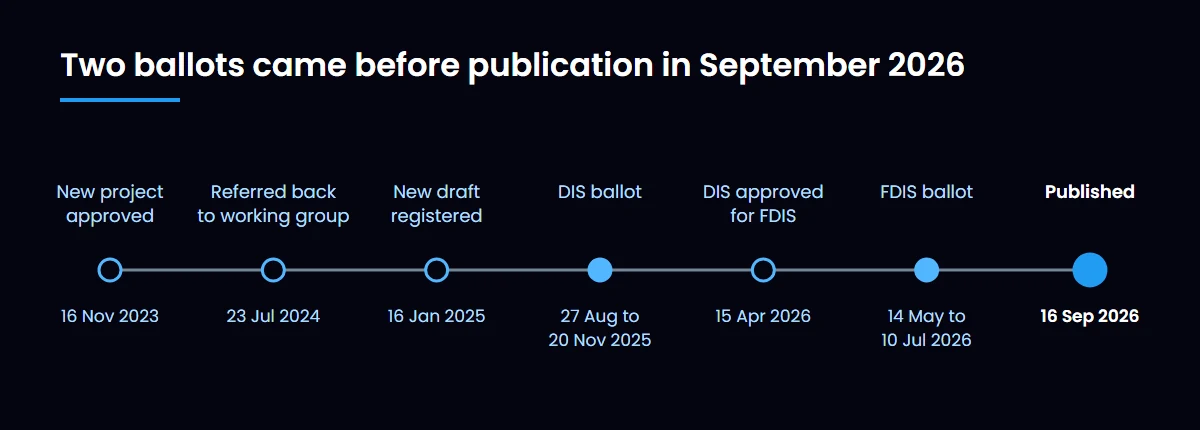
On ISO's stage record, the revision ran from a new project approved on 16 November 2023 to the ISO 9001:2026 release date of 16 September 2026.
Why ISO revised the standard: the fifth edition dates from 2015, and ISO reviews its standards periodically. After a global consultation in 2023, a consensus confirmed that a revision would enhance the standard's value.
How the drafts moved: the ISO 9001:2026 draft was referred back to the working group on 23 July 2024, and a new draft was registered on 16 January 2025. The ISO 9001:2026 DIS, the Draft International Standard, then went to a 12-week ballot from 27 August to 20 November 2025. ISO approved it for registration as a Final Draft International Standard (FDIS) on 15 April 2026, and the FDIS ballot ran from 14 May to 10 July 2026. Figure 2 shows the ISO 9001:2026 revision timeline stage by stage.
The convenor's view: the ISO 9001:2026 news came with a quote from the revision's convenor, in ISO's September 2026 news release:
"Bringing together experts across industries, sectors and countries enabled us to challenge ideas, build consensus and develop a standard that reflects the different realities organizations face today."
Sam Somerville, Chair of ISO/TC 176 Subcommittee 2 and Convenor of the international working group that led the revision of ISO 9001
ISO's record now gives the ISO 9001 revision status as published. The resulting edition "cancels and replaces the fifth edition (ISO 9001:2015)" as a technical revision of it.
ISO 9001:2026 Draft Changes: What Changed from ISO 9001:2015
The DIS and FDIS drafts are superseded: the ISO 9001:2026 changes below are those of the published standard, described in its Foreword and by ISO and Global ACI. Table 3 lists the main clause changes in the ISO 9001:2026 revision, as Global ACI's transition document gives them; Global ACI notes that its list is not exhaustive:
Table 3. Main clause changes in ISO 9001:2026
| Clause | What changed |
|---|---|
| 3 | Core management system terms added; ISO 9000 remains the normative reference |
| 5.1.1 | New item i) on quality culture and ethical behavior added; "continual" improvement replaces "improvement"; new NOTE 2 added |
| 5.2.1 | Elements of item a) moved to item e): the quality policy takes into account the context and supports strategic direction |
| 6.1 | Split into 6.1.1, 6.1.2, and 6.1.3 |
| 6.3 | New items e), f), and g) added on effectiveness, communication, and review of changes |
| 7.3 | Awareness of organizational quality culture and ethical behavior added |
| 9.3.2 | Management review "shall include" its inputs; new input c) on interested parties added |
| Annex A, Annex B | Annex A revised as informative text; Annex B removed |
Sources: ISO 9001:2026 Foreword (4); Global ACI-TECH-3-TR 2029-09-30 (M), section 3 (5); read October 2026.
Quality Culture and Ethical Behavior (Clauses 5.1.1 and 7.3)
Quality culture and ethical behavior now sit within the requirements, "particularly in relation to leadership, awareness and the environment for the operation of processes." Clause 5.1.1 on leadership and commitment adds a new item i) promoting both. It also replaces promoting "improvement" with promoting "continual" improvement. A new NOTE 2 says an organization's quality culture and ethical behavior are reflected "in its shared values, attitudes, and established practices." Clause 7.3 adds awareness of them.
In practice, we suggest checking that your leadership commitments and awareness material address quality culture and ethical behavior, in your own words or the standard's.
A Quality Policy Linked to Strategic Direction (Clause 5.2)
Elements that sat in item a) of Clause 5.2.1 move to item e), which now says the quality policy "takes into account the context of the organization and supports its strategic direction." ISO describes the policy as "more explicitly linked to the organization's context and strategic direction," reinforcing the quality management system as a tool for achieving business objectives. In practice, our advice is to read your current quality policy beside your latest strategy document and check that each refers to the other.
Separate Subclauses for Risks and Opportunities (Clauses 6.1.1 to 6.1.3)
Risks and opportunities now get their own subclauses: Clause 6.1 splits into 6.1.1 Determining risks and opportunities, 6.1.2 Actions to address risks, and 6.1.3 Actions to address opportunities. The Foreword sums it up: risks and opportunities "are more clearly distinguished, with separate consideration of actions to address each." The Introduction pairs risk-based thinking "aimed at preventing undesired results" with opportunity-based thinking "aimed at pursuing desired results by taking advantage of opportunities." In practice, we suggest keeping opportunities and their actions visibly apart from risks in the register or planning record you already use.
Stronger Planning of Changes (Clause 6.3)
The Foreword says the requirements on changes to the quality management system "have been reinforced to support the achievement of intended results." The second paragraph of Clause 6.3 now begins "To ensure changes are implemented effectively to achieve intended results," and the clause adds three items to plan for:
- e) how the effectiveness of the changes will be monitored and evaluated;
- f) communication of the changes;
- g) how to review the results of the changes.
In practice, we suggest adding three fields to the change request or project template you already use: the measure of success, the people to inform and the review date.
New Management Review Inputs (Clause 9.3.2)
The management review "shall include" its inputs under Clause 9.3.2 of the 2026 edition, where the 2015 text said the review "shall be planned and carried out taking into consideration" those inputs. A new input c) covers "changes in needs and expectations of interested parties that are relevant to the quality management system," and the inputs after it are reorganized as d) to g). In practice, we suggest a standing agenda item for changes in interested parties' needs and expectations, with the review's decision on each one recorded, so the minutes show the new input was covered.
Continual Improvement in Clause 10.1
In the 2026 contents, Clause 10 has two subclauses and no third: 10.1 Continual improvement and 10.2 Nonconformity and corrective action. The Introduction says an organization "can pursue continual improvement in various ways, such as incremental or breakthrough change, innovation or reorganization initiatives." In practice, we suggest checking that your improvement records show more than corrective actions, for example a planned innovation or a reorganization, since the Introduction names both as routes to continual improvement.
Climate Change Considerations from the 2024 Amendment
ISO published the 2024 climate amendment to ISO 9001:2015, ISO 9001:2015/Amd 1:2024, Climate action changes, in February 2024. The 2026 edition incorporates it and, in ISO's words, "carries forward the consideration of climate change introduced into ISO 9001:2015 through the 2024 amendment." In practice, if your 2015 system has not yet addressed the climate amendment, we suggest closing that gap first, since ISO carries its consideration of climate change into the 2026 edition.
Clause 3 Terms and Documented Information Wording
Clause 3 now holds a limited number of core management system terms and definitions, while ISO 9000 is still the normative reference for quality management terms and definitions. Among the new entries are quality management system (3.4.1) and quality policy (3.5.1), and Clause 2 cites ISO 9000 without a date. Global ACI also notes clarified wording that "documented information shall be available." In practice, we suggest mapping your procedures' terms to the Clause 3 definitions, though the Introduction says the standard does not imply the need to use its terminology.
Expanded Annex A and Removal of Annex B
Annex A stays informative. The Foreword says it "has been revised to provide enhanced clarification of the structure, terminology and intent of the requirements" without adding requirements. Annex B, which listed other ISO/TC 176 standards, is removed; those references moved into Annex A and onto the ISO/TC 176 website. In practice, we suggest reading Annex A when a clause's intent is unclear and treating it as explanation, not as a list of new requirements.
Across the edition as a whole, beyond the headline changes above, ISO says the standard brings "a range of smaller refinements and editorial clarifications" that reflect "the realities of modern business," and it names four of those realities:
- digitalization;
- organizational knowledge;
- increasingly complex supply chains;
- resilience.
What Stays the Same in ISO 9001:2026
The foundations stay. ISO names four that stay at the center of the standard:
- customer focus;
- the process approach;
- risk-based thinking;
- continual improvement.
The clause structure stays too: ISO 9001:2026 keeps the Harmonized Structure used across ISO management system standards, which ISO says makes it easier to integrate with other management systems. If you also run ISO 27001, the shared structure means you can plan updates to both management systems together.
For a 2015 system, ISO's message is that "A new edition of ISO 9001 does not mean starting again." Global ACI calls the overall changes to the standard "minimal." The new edition does not require any of the following:
- A rebuilt quality management system: ISO advises keeping what works in your existing system and making targeted changes where needed.
- A fresh certification process: certified organizations do not start the certification process again.
- New requirements from Annex A: the annex is informative and adds none.
- A new certificate on publication day: accredited 2015 certificates stay valid within their own cycle, until 30 September 2029 at the latest.
How to Prepare for the ISO 9001:2026 Transition
ISO's explainer for businesses sets out five steps for taking your system through the ISO 9001:2026 updates:
- Buy the standard and read the changes. Order the ISO 9001:2026 standard from ISO's store, where a Redline version is among the formats, then compare it with the 2015 edition clause by clause, starting from the Foreword's list of main changes. If your 2015 system has not yet addressed the climate amendment published in February 2024, start there.
- Run a gap assessment against the 2026 text. ISO's second step is a gap analysis that shows where your system "already meets the ISO 9001:2026 requirements and where improvements are needed." A clause-by-clause ISO 9001 gap assessment returns a prioritized list of what has to change before an audit.
- Update processes and documented information. Change the processes, documented information, and governance that the gaps point to, and use the occasion "to simplify, streamline or improve" how the system supports the business, as ISO suggests. Smaller teams can keep this proportionate; CyberCrest's guide to ISO 9001 for small businesses covers documentation and internal audits at that scale.
- Brief your people on quality culture. Make sure leaders, managers, and employees understand the changes and their own role, as ISO's fourth step asks. Cover the new awareness item on quality culture and ethical behavior in Clause 7.3 e) in those briefings.
- Check the system, then book the transition audit. We suggest testing the changes with an internal audit and a management review. Then agree on a transition plan with your certification body, which is ISO's fifth step for certified organizations. Book the transition audit well before 30 September 2029 rather than close to it. When you plan the budget, transition audits are one line to check: they may add audit time, and the certification body decides whether they do.
Questions About ISO 9001:2026? Talk to a Compliance Expert
Our ISO 9001 consulting services start with a gap assessment that measures your processes and documentation against every clause of ISO 9001. What comes next depends on where you stand:
- Already certified: use the gap assessment report to plan the changes your quality management system needs.
- Working toward certification: our internal audit checks the implemented system against the standard and your own procedures before a certification body does.
- New to ISO 9001: we develop the quality policy, objectives, procedures, and work instructions your quality management system needs, and support your team through implementation.
Talk to our team about where your quality management system stands today.
Sources
- ISO, ISO 9001:2026 Quality management systems: Requirements (standard page and life cycle). https://www.iso.org/standard/9001
- ISO, ISO 9001:2015 Quality management systems: Requirements (withdrawn). https://www.iso.org/standard/62085.html
- ISO, ISO 9001:2015/Amd 1:2024 Quality management systems: Requirements, Amendment 1: Climate action changes. https://www.iso.org/standard/88431.html
- ISO, ISO 9001:2026 Quality management systems: Requirements, Foreword, Introduction and Clauses 1 to 3 (official sample, SIST). https://cdn.standards.iteh.ai/sist-preview/iso/iso-9001-2026/f019c820593640a0a84140a0acb8be6d/iso-9001-2026.pdf
- Global ACI, Global ACI-TECH-3-TR 2029-09-30 (M), Transition Requirements for ISO 9001:2026, version 1.1. https://sys.global-aci.org/uploads/documents/TECH-3-TR_2029-09-30_(M)_ISO_9001_2026_Transition_v1_12.pdf
- ISO, ISO 9001:2026: What businesses need to know. https://www.iso.org/quality-management/iso-9001-2026
- ISO, ISO 9000:2026 Quality management: Fundamentals and vocabulary. https://www.iso.org/standard/9000
- Global ACI, About Global ACI. https://global-aci.org/en/about-global-aci/
- ISO, ISO launches update to world's most widely used quality management standard for a new era of business (news release, 16 September 2026). https://www.iso.org/news/2026/09/ISO9001-2026








FAQ
Where can I get the ISO 9001:2026 PDF?

ISO sells the full ISO 9001:2026 PDF on its page for the standard, in several formats with a Redline version among them. SIST, the Slovenian standards body, publishes a free preview of ISO 9001:2026 that includes the Foreword, which lists the six main changes. The DIS and FDIS drafts are superseded by the published text.
Do employees need ISO 9001:2026 training?
Clause 7.3 of the new edition adds awareness of organizational quality culture and ethical behavior, according to Global ACI's transition document. ISO describes this as new awareness requirements on quality culture and ethical behavior. Its transition steps also ask that leaders, managers, and employees understand the changes and their role. We suggest covering both points in the briefings you already run.
How much does ISO 9001 certification cost in 2026?
Your ISO 9001 certification cost, 2026 audits included, is quoted by your certification body, so ask it early for a quote that fits your scope. If you are already certified, also ask whether the transition audit needs extra audit time: under Global ACI's transition rules, the certification body decides. The standard itself is sold separately by ISO, in several formats.
When was ISO 9001:2026 released?
The new edition came out on 16 September 2026, after a final draft ballot that closed on 10 July 2026. It replaced ISO 9001:2015, and accredited certificates move to it through a transition that ends on 30 September 2029 under Global ACI's rules.
Is ISO 9001:2015 still valid?
Not as a standard: ISO has withdrawn ISO 9001:2015 and says it is no longer the current edition. Accredited ISO 9001:2015 certificates stay valid within their own certification cycle, until 30 September 2029 at the latest, unless they are transitioned to ISO 9001:2026 under Global ACI's rules.
About the author

Ron Gupta
—
Senior Director: Governance, Risk and Compliance
Getting his start in tech as an analyst and founder at Via Digital ID, Ron brings to the table a unique approach to cyber security. With over a decade of experience in GRC, Ron has developed and honed a skillset rich in combined audit and assessment as well as risk management and mitigation.
Ron’s ability to convey critical information, results and plans of action to executive leadership is a key skill that allows him to propel the clients he engages with to success. Ron is adept at taking target frameworks, implementing them within environments while reducing overall risk to organizations.