CMMC Final Rule: Where It Stands Today
Published on
November 26, 2026
See which assessments remain in force, how the Phase 2 suspension affects contract requirements, and what to check before award or option exercise.
The CMMC final rule is in effect. Phase 2 was due to start on November 10, 2026. It is suspended. As of November 2026, applicable defense procurements can still require Level 1 (Self) or Level 2 (Self). A restart date remains unannounced.
Start with the latest version of your solicitation, contract, or subcontract. This guide shows where to find the required CMMC level, what to verify in the Supplier Performance Risk System (SPRS), and what to do if your paperwork still calls for a third-party assessment.
Key Takeaways
- CMMC 2.0 current status: both rules remain in force. The program rule defines the assessments and statuses. The acquisition rule makes CMMC a condition of award when a solicitation requires it.
- The rollout remains in Phase 1. Phase 2 and later milestones are suspended until further notice.
- Contract duties continue. Keep required self-assessments and affirmations current. Where a contract carries Defense Federal Acquisition Regulation Supplement (DFARS) clause 252.204-7012, its safeguarding duties still apply.
- Prepare now. Keep your assessment evidence current and check when your next SPRS affirmation is due.
Table 1. What to check in your situation
| Situation | What to check |
|---|---|
| You are bidding | Provision 252.204-7025 in the solicitation and every amendment. If it still names Level 2 (C3PAO) or Level 3 (DIBCAC), ask the contracting officer in writing. |
| An option or extension is coming on your contract | Clause 252.204-7021 and every executed modification. If Level 2 (C3PAO) or Level 3 is still there, ask when the contract will be modified. |
| You are a subcontractor | Ask the prime to confirm in writing the current CMMC level for your subcontract and whether its terms changed. |
Sources: the acquisition memorandum, DFARS subpart 204.75 and clause 252.204-7021, and 32 CFR 170.23 (1, 2, 3, 4); read November 2026.
What Is the CMMC 2.0 Final Rule?
Two final rules govern Cybersecurity Maturity Model Certification (CMMC) in defense contracts. The 32 CFR Part 170 program rule defines the levels and assessments. The DFARS acquisition rule brings those requirements into applicable solicitations and contracts. CMMC gives the Department of Defense (DoD) a way to verify how contractors safeguard two kinds of information:
- Federal contract information (FCI): information not intended for public release that is provided by or generated for the government under a contract to develop or deliver a product or service.
- Controlled unclassified information (CUI): information that a law, regulation, or government-wide policy requires or permits an agency to handle with safeguarding or dissemination controls.
Reviews by the DoD Inspector General and the Defense Contract Management Agency (DCMA) found that contractors did not consistently implement the security requirements that already applied to CUI.
The rule sets three levels, scaled to the type and sensitivity of the information:
- FCI, Level 1: the 15 basic safeguarding requirements of Federal Acquisition Regulation (FAR) clause 52.204-21, checked by an annual self-assessment.
- CUI, Level 2: the 110 requirements of National Institute of Standards and Technology (NIST) SP 800-171 Revision 2, checked by a self-assessment or by a CMMC Third-Party Assessment Organization (C3PAO).
- Level 3: 24 more requirements selected from NIST SP 800-172, assessed by the DCMA Defense Industrial Base Cybersecurity Assessment Center (DIBCAC).
Our compliance guide walks through each CMMC level in practice, from the 15 basic safeguards of Level 1 to the C3PAO and DIBCAC assessments.
The CMMC Program Rule (32 CFR Part 170)
Part 170 is where a contractor finds the assessment rules for the CMMC levels, the conditional and final statuses, and the phased implementation. DoD published the CMMC Program final rule at 89 FR 83092 on October 15, 2024, and it took effect on December 16, 2024. If your team prepared under the earlier model, our comparison of how CMMC 2.0 differs from CMMC 1.0 walks through what changed and how each level now works.
The CMMC Acquisition Rule (48 CFR) and DFARS Clause 252.204-7021
The acquisition rule puts CMMC into DoD solicitations and contracts through two DFARS texts:
- Provision 252.204-7025 tells offerors the required CMMC level before award; a solicitation that includes clause 252.204-7021 also includes this provision.
- Clause 252.204-7021 makes keeping a current CMMC status at that level or higher a duty for the life of the contract.
The Federal Register published the Defense Federal Acquisition Regulation Supplement acquisition rule at 90 FR 43560 on September 10, 2025, and it took effect on November 10, 2025, which started Phase 1.
Who Must Comply With the CMMC Final Rule
CMMC applies to DoD contractors and subcontractors that will process, store, or transmit FCI or CUI on contractor information systems for a contract that includes CMMC requirements. Under 32 CFR 170.23, prime contractors must require their subcontractors to comply with CMMC requirements and to flow them down in turn, so the requirements reach all tiers of the supply chain. The information each subcontractor handles sets its minimum level:
- a subcontractor that handles only FCI needs Level 1 (Self);
- one that handles CUI needs at least Level 2 (Self);
- if the prime contract requires a C3PAO or DIBCAC assessment, a subcontractor handling CUI needs at least Level 2 (C3PAO).
The program office or requiring activity selects the level for each contract by the type of information, and the contracting officer writes it into the solicitation and contract. Solicitations and contracts solely for commercially available off-the-shelf (COTS) items are excluded.
CMMC Implementation Timeline
Under the CMMC final rule published in 2024, CMMC requirements enter DoD contracts in four phases. Phase 1 is the only phase that applies today, and the recurring deadlines of the levels it allows are set out in the section on CMMC self-assessments and annual SPRS affirmations.
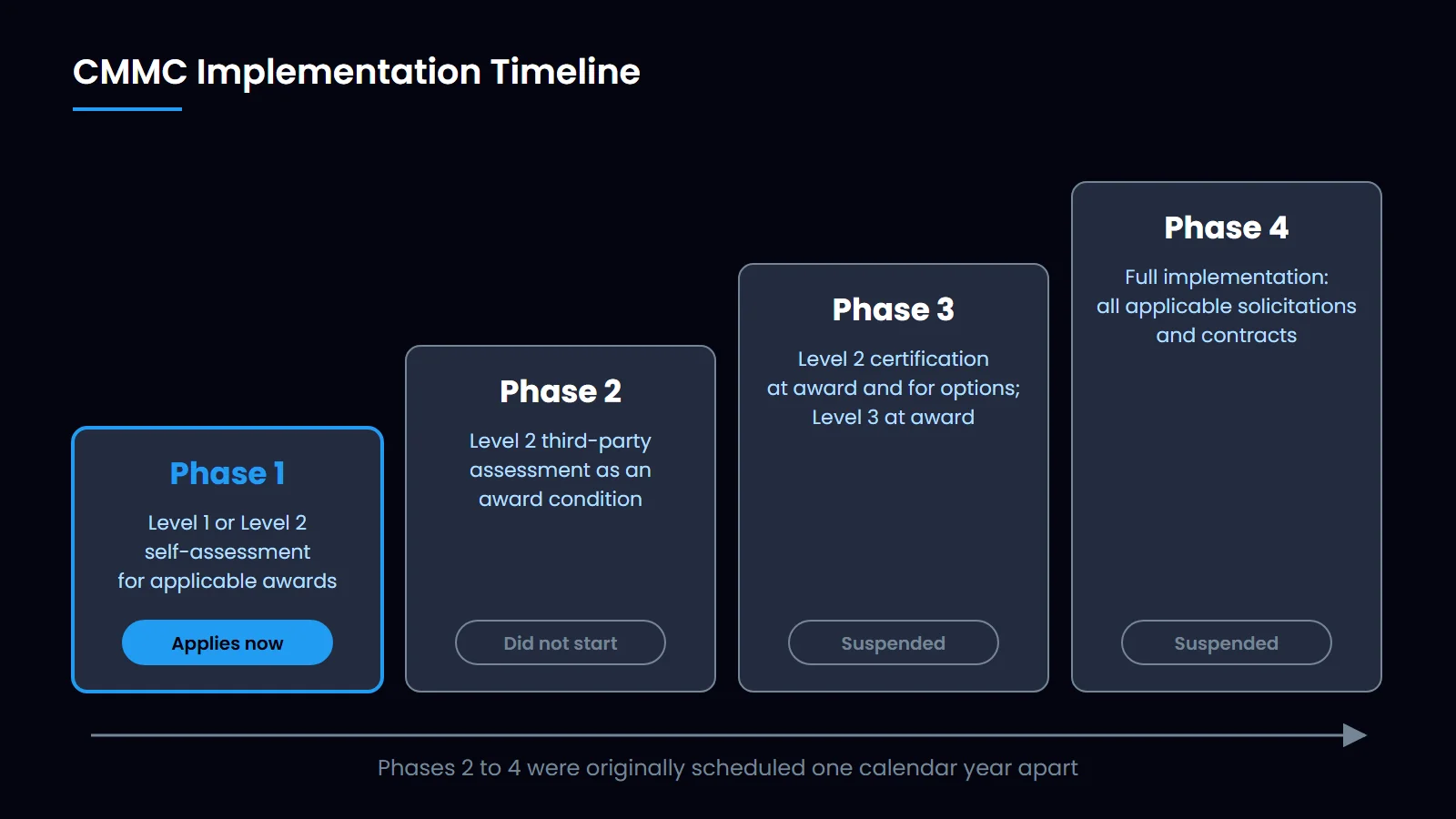
32 CFR 170.3(e) starts each later phase one calendar year after the previous one. DFARS 204.7504 is the source of the Phase 4 date: from November 10, 2028, it puts the CMMC clause into solicitations and contracts whenever the contractor will handle FCI or CUI on its own information systems. Besides the COTS exclusion under Who Must Comply, the rule excepts contracts for which a DoD acquisition executive has waived CMMC requirements in very limited circumstances. Neither Phase 3 nor Phase 4 is active.
Table 2. CMMC phases: original schedule and current status
| Phase | Original schedule | Requirements under the original rollout | Current status |
|---|---|---|---|
| Phase 1 | November 10, 2025 | Level 1 (Self) or Level 2 (Self) at award for applicable contracts; DoD may require Level 2 (C3PAO) instead | In force; only self-assessments may be designated |
| Phase 2 | November 10, 2026 | Level 2 (C3PAO) at award for applicable contracts; DoD may delay it to an option or require Level 3 | The scheduled start did not occur. Restart date unannounced. |
| Phase 3 | One year after Phase 2 starts | Level 2 (C3PAO) also when exercising options; Level 3 (DIBCAC) at award for applicable contracts | Suspended |
| Phase 4 | November 10, 2028 | All applicable solicitations and contracts, including option periods on earlier contracts | Suspended |
Sources: 32 CFR 170.3(e), DFARS 204.7504, the department's release, and the CIO and acquisition memoranda (1, 2, 5, 6, 7, 8); read November 2026.
Table 3. Key dates in the CMMC rollout
| Date | Event |
|---|---|
| November 10, 2025 | The DFARS acquisition rule took effect and CMMC Phase 1 began |
| July 13, 2026 | The department announced the suspension and released the two implementation memos |
| September 3, 2026 | Revision 3 of the class deviation superseded Revision 2 of July 16 and kept its direction to contracting officers |
Sources: the DFARS final rule, the CIO's About CMMC page, the department's release, the two memoranda, and the class deviation (1, 6, 7, 9, 10, 11); read November 2026.
The Latest CMMC Rule Update: Phase 2 Suspended
The planned transition to Phase 2 did not happen, and new procurements can still require Level 1 (Self) or Level 2 (Self). The suspension comes from DoD, which may use the secondary title Department of War (DoW) under a September 2025 executive order. DoW announced the immediate suspension on July 13, 2026. Two memos set the policy and the procurement instructions, and a September class deviation tells contracting officers how to apply the pause to solicitations and contracts.
What the CMMC Suspension Memos and Class Deviation Changed
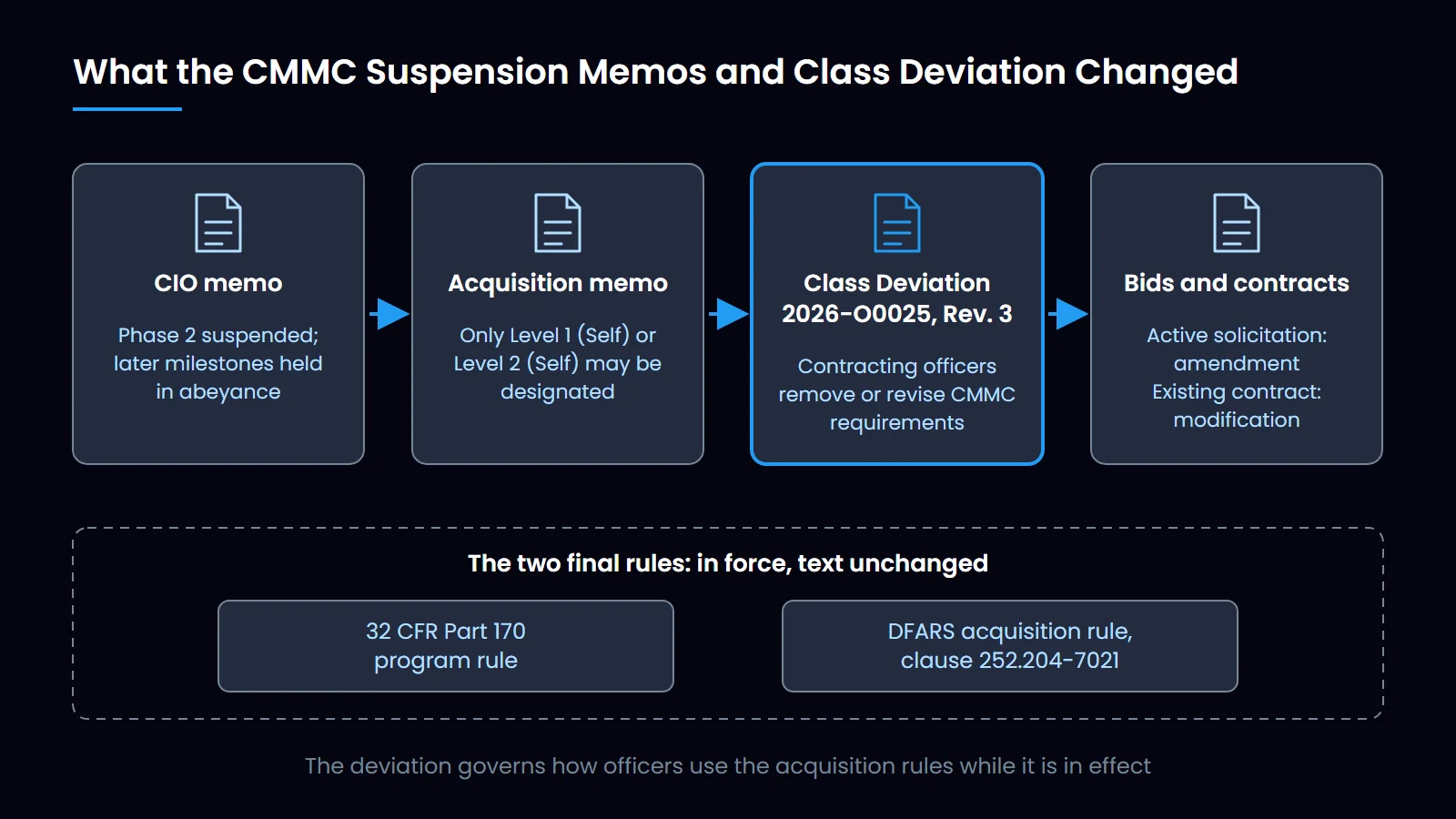
Contracting officers amend an affected active solicitation as soon as practicable to remove Level 2 (C3PAO) or Level 3 requirements. They remove the same requirements from existing contracts by modification, before the next option is exercised or at the next scheduled administrative modification.
- The CIO memorandum, signed by Chief Information Officer Kirsten A. Davies, holds the later milestones in abeyance until further notice and keeps Level 1 and Level 2 self-assessments in scope.
- The acquisition memorandum, signed by Under Secretary of War for Acquisition and Sustainment Michael P. Duffey, sets the procurement instructions above and bars CMMC waivers during the review.
- DFARS Class Deviation 2026-O0025, Revision 3, signed by John M. Tenaglia on September 3, 2026, tells contracting officers to work with requiring activities to remove or revise CMMC requirements.
The deviation does not amend the text of the DoD CMMC final rule in either the program rule or the acquisition rule. It stays in effect until it is rescinded or written into the regulations.
Why the Department of War Suspended CMMC Phase 2
In its announcement, DoW cited bureaucratic burdens and prohibitive compliance costs. The CIO memo added a third reason: shortages in third-party assessment capacity.
Has CMMC Level 2 Been Suspended?
Level 2 (Self) can still be required. New Level 2 (C3PAO) designations are suspended. Contractors can still seek a C3PAO assessment on their own, as the section on existing Level 2 (C3PAO) certifications explains.
Table 4. Assessments a buying office may designate during the suspension
| May be designated | May not be designated |
|---|---|
| Level 1 (Self) | Level 2 (C3PAO) |
| Level 2 (Self) | Level 3 (DIBCAC) |
Sources: the acquisition memorandum (1); read November 2026.
CMMC Requirements That Still Apply Today
Where the solicitation or contract requires CMMC, a current status and a current affirmation in SPRS are still conditions for award, option exercise, and extension. Contracts with DFARS 252.204-7012 keep its safeguarding and incident-reporting duties.
CMMC Self-Assessments and Annual SPRS Affirmations
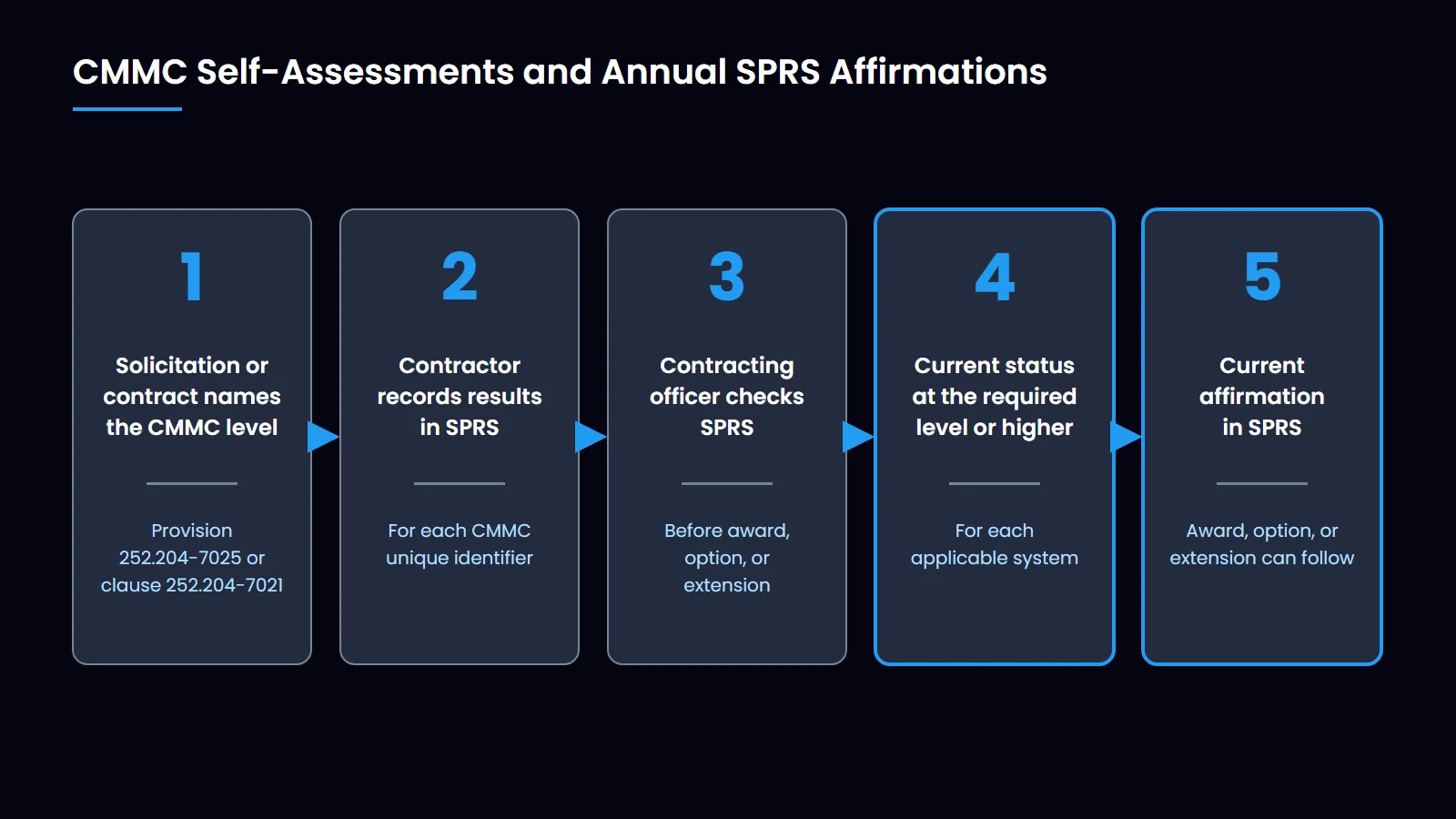
In Phase 1, the CMMC deadlines recur by level. Under the CIO's Phase 1 program guidance, Level 1 requires a self-assessment and an affirmation every year. Level 2 (Self) requires a self-assessment every three years and an affirmation every year. A Final Level 2 (Self) status stays current for up to three years from the CMMC Status Date if the affirmation is no more than one year old.
Where CMMC applies, DFARS subpart 204.75 directs the contracting officer to check SPRS before contract award, option exercise, or extension of the performance period. The officer looks for:
- a current status at the required level or higher for each CMMC unique identifier (UID) of an information system that will process, store, or transmit FCI or CUI on the contract;
- an affirmation of continuous compliance, no more than one year old, for each applicable CMMC UID.
A CMMC UID is the 10-character alphanumeric code assigned to each CMMC assessment and shown in SPRS for each contractor information system.
CMMC POA&M Rules and Conditional Status
Level 1 has no conditional path: a Level 1 self-assessment allows no plan of action and milestones (POA&M), so Level 1 needs a final status for award. At Level 2, 32 CFR 170.21 lets a contractor reach a conditional status with a POA&M for some requirements scored NOT MET, and the limits are the same for a self-assessment and a C3PAO certification assessment:
- the assessment score must be at least 88 of the 110 points;
- each requirement on the POA&M must be worth no more than 1 point, except CUI encryption that is in place but not validated under the Federal Information Processing Standards (FIPS);
- six Level 2 requirements are ineligible for a POA&M, including the system security plan (the list in 32 CFR 170.21).
A conditional status at Levels 2 and 3 is valid for up to 180 days from the CMMC Status Date, and award can occur with it. Within that period, a POA&M closeout assessment of the open requirements must confirm that they are closed, or the conditional status expires. After a self-assessment, the contractor performs the closeout in the same manner as the first assessment. When a C3PAO did the assessment, an authorized or accredited C3PAO performs the closeout. A successful closeout turns the conditional status into a final one.
CMMC Affirmations and False Claims Act Risk
Each year, the affirming official confirms in SPRS continuous compliance with the CMMC level the contract requires, for each CMMC unique identifier, as DFARS 252.204-7021 requires. Before submitting, check the assessment results, the system security plan, and the evidence for each requirement against the current environment. An inaccurate affirmation can raise False Claims Act risk, depending on the facts.
On November 3, 2026, the Justice Department announced a $13 million settlement with ILC Dover and ILC Astrospace over alleged failures to meet the cybersecurity requirements in their contracts from January 2018 to October 2024, before the CMMC program rule took effect. The claims are allegations only, with no determination of liability.
“We will continue our efforts to hold accountable government contractors and subcontractors that fail to meet their cybersecurity commitments.”
Brett A. Shumate, Assistant Attorney General, Civil Division, U.S. Department of Justice, November 3, 2026
DFARS 252.204-7012 and NIST SP 800-171: CMMC Still Uses Revision 2
For CMMC Level 2 assessments, the program rule uses NIST SP 800-171 Revision 2. For the safeguarding duties of DFARS 252.204-7012, check which version of the clause your contract carries. In the class-deviation version, a separate deviation specifies Revision 2 until Revision 3 comes in through future rulemaking, as the CIO's CMMC program FAQ explains. Otherwise, the clause points to the NIST SP 800-171 requirements in effect when the solicitation was issued or as the contracting officer authorizes.
During the suspension, the acquisition memorandum says DoW enforces baseline compliance with Revision 2 through self-assessments and select government-led assessments rather than third-party certifications, and that DFARS 252.204-7012 remains in effect. Where it applies, contractors must report cyber incidents within 72 hours of discovery. The same FAQ says you can implement Revision 3 using DoD's organization-defined parameters, but CMMC assessments use Revision 2 until that separate deviation is withdrawn or superseded, so close gaps against Revision 2. Want to see how NIST SP 800-171 work carries over to CMMC Level 2? Read our comparison of CMMC vs NIST 800-171.
For anyone checking a contract. Since February 1, 2026, contracting officers have used DFARS 240.371 from the original version of Class Deviation 2026-O0025 instead of the codified subpart 204.75. Revision 3 now carries that text, with the same SPRS check and clause dates. The NIST SP 800-171 DoD Assessment Requirements clause is listed there as 252.240-7997, and the old number 252.204-7019 does not appear.
Does an Existing CMMC Level 2 (C3PAO) Certification Still Count?
Yes: an existing Level 2 (C3PAO) status can satisfy a Level 2 (Self) requirement, because the acquisition rule accepts a current status at a level equal to or higher than the one the solicitation or contract requires. The status must be current and its CMMC UIDs must cover each information system that processes, stores, or transmits FCI or CUI on that contract. The Cyber AB's statement on the suspension says C3PAO Level 2 certification assessments remain available.
CMMC Flowdown for Prime Contractors and Subcontractors
If you are the prime, DFARS 252.204-7021 makes you pass the correct CMMC level to relevant subcontracts under the flowdown rules in Who Must Comply. It also requires you to ensure that subcontractors and suppliers complete the required affirmation before subcontract award and maintain it annually.
If you are a subcontractor, your required level comes through the prime's flowdown, so the terms of your subcontract are the ones to check. You flow the requirements down in turn to any of your own subcontractors that will handle FCI or CUI; the flowdown step under How to Prepare covers what to confirm in writing.
What Comes Next for CMMC: The Reform Task Force and Rulemaking
DoW set up the CMMC Reform Task Force to review the certification program. The July release gave the task force 60 days to deliver its final report to the CIO; that was a deadline for the report, not a date for publishing it. As of November 2026, the CIO's CMMC program page listed only the July release and the two memos, with no task force report and no date to resume Phase 2.
When will CMMC 2.0 rulemaking be completed? The original CMMC rulemaking is complete: it ended with the two final rules, and a Federal Register search found no later CMMC proposed or final rule. A separate rulemaking to move CMMC from NIST SP 800-171 Revision 2 to Revision 3 is still pending, with no current completion date. It has passed the date it was listed for: the Unified Agenda published on August 14, 2026 listed an interim final rule for July 2026, and none had appeared by late November 2026.
How to Prepare for CMMC Compliance
Start with the CMMC level your contracts require; the CIO's FAQ names a careful self-assessment as the best way to prepare. The ten steps below fall into five stages: scope, assess, fix and document, submit and affirm, and maintain.
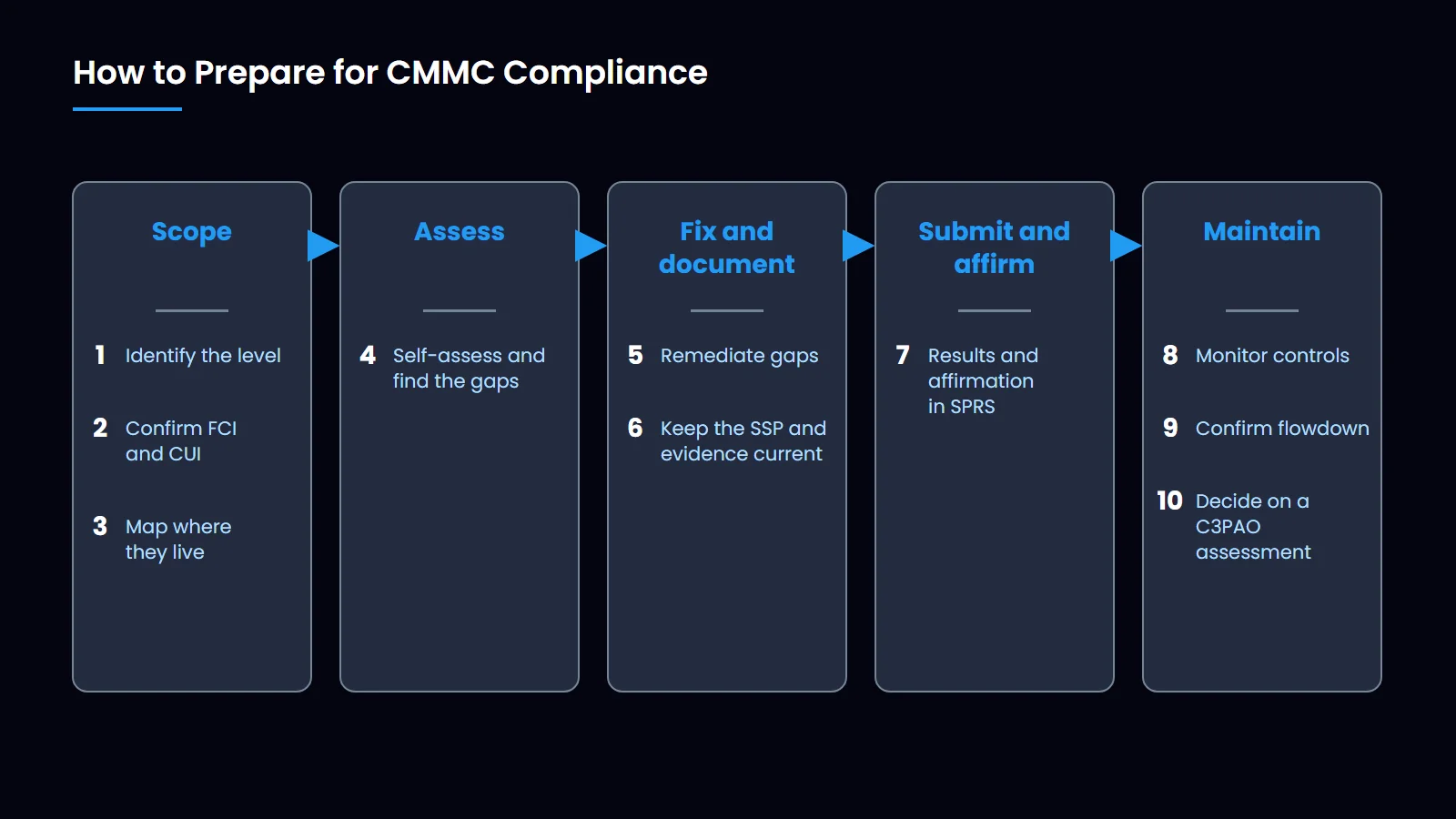
1. Identify the CMMC Level Your Contracts Require
For each bid, read provision 252.204-7025 in the solicitation and in every amendment. For an existing contract, read the contract clauses, starting with 252.204-7021, which names the required level, and every executed modification. If either still names Level 2 (C3PAO) or Level 3 (DIBCAC), ask the contracting officer in writing whether it will be removed. Record the level for each information system that will handle FCI or CUI.
2. Confirm Which Information Is FCI and Which Is CUI
Ask the contracting officer, or your prime, for three answers in writing:
- which categories of information you will receive are FCI and which are CUI;
- what markings the CUI carries, with samples;
- how the information will be transferred to you.
Check the markings against the DoD CUI Quick Reference Guide that the CIO's FAQ points to. Use those answers to map your assessment scope.
3. Map Where FCI and CUI Live and Set Your Assessment Scope
List everything that stores, processes, or transmits FCI or CUI:
- information systems, such as email, enterprise resource planning (ERP) and computer-aided design (CAD) tools, or supplier portals, and the data flows between them;
- the people and roles who handle the information;
- external service providers, such as cloud and managed service providers.
Trace at least one CUI flow from end to end. For example, a marked drawing may arrive by email, sit in a CAD tool, and go to a supplier through a portal.
At Level 2, also include the Security Protection Assets, the systems that protect the environment inside the assessment boundary, such as a service that holds the passwords granting access to it. Under 32 CFR 170.19, they belong in the Level 2 assessment scope. Draw the assessment boundary around all of these before you assess anything; an enclave can keep that boundary small, as our guide to CMMC scope and enclaves explains. Keep the map current, because a new system or provider inside the boundary changes what you must protect.
4. Conduct a Self-Assessment and Gap Analysis
Assess each control your level requires: the 15 Level 1 requirements of FAR 52.204-21 or the 110 Level 2 requirements of NIST SP 800-171 Revision 2. Record every requirement you do not meet and the reason. The NIST 800-171 compliance checklist can structure the Revision 2 review. Have a second reviewer check whether the evidence supports each requirement you marked as met. The output of this step is a list of requirements with their status, the evidence for each, and the open gaps.
Outside help: the Cyber AB marketplace that the CIO's FAQ points to lists certified CMMC assessors, professionals, and registered practitioner organizations that companies can engage to prepare. Under 32 CFR 170.17, a Level 2 certification assessment comes from an authorized or accredited C3PAO. The law firm Crowell & Moring suggests that contractors consider running readiness assessments under attorney-client privilege to limit the risk of disclosing findings in litigation or an investigation. That is a firm's recommendation, not a CMMC requirement.
5. Remediate Gaps and Use a POA&M Only Where CMMC Allows It
Fix the gaps in order of risk, then reassess the controls you fixed. Keep an internal remediation list for every open gap, and put an item on a formal POA&M only where the limits under CMMC POA&M Rules and Conditional Status allow it; Level 1 allows none. Assign an owner and a date to every open item, and complete the closeout assessment within the conditional period.
6. Keep Your System Security Plan and Evidence Current
Update the system security plan (SSP) whenever the environment changes. It should describe the current boundary, the system components, and how each requirement is implemented. Keep your policies, incident response plan, and training records with it. The CIO's FAQ says a Level 2 self-assessment without an up-to-date SSP cannot be completed, and that assessment shows no score in SPRS. Keep the evidence for each control in one place, so the affirming official can review it before submitting.
7. Submit Results to SPRS and Keep the Annual Affirmation Accurate
Enter your self-assessment results in SPRS. Have the affirming official submit an affirmation after each assessment, including a POA&M closeout, and renew it annually after Final status, as 32 CFR 170.22 requires. Before award, an option exercise, or an extension, verify that SPRS shows a current status and affirmation for each applicable system. The section on CMMC affirmations and False Claims Act risk explains why accuracy matters.
8. Monitor Controls Continuously and Run Regular Security Reviews
Test your controls throughout the year, including the months between affirmations. Review accounts, access rights, policies, and training on a set schedule. Report each significant change, such as a new system or provider inside the boundary, to the affirming official. The CIO's FAQ counts continuous monitoring of security controls among the requirements that address changes, and it leaves the decision on reassessment to the affirming official.
At Level 2, make everyone who uses the systems in scope aware of the security risks of their work and of the security policies and procedures that apply; that includes managers and system administrators. Train staff for their assigned security duties, as the awareness and training requirements of NIST SP 800-171 call for.
9. Confirm Flowdown and Contract Changes in Writing
As a subcontractor, ask the prime which CMMC level it flows down and how a modification of the prime contract changes your contractual requirements. As the prime, review your subcontracts after each amendment or modification. For each change, keep a record of the level, the date or condition, and a reference to the document that changed it.
10. Decide on a C3PAO Assessment and Track Official Updates
If you already have a C3PAO assessment booked, check the current requirement in your contract or subcontract before changing the date. Unless your contract or subcontract still carries a Level 2 (C3PAO) requirement, a C3PAO assessment is voluntary while buying offices cannot designate that level. Weigh the cost against what your primes ask for; our CMMC assessment guide explains how the assessment runs and what evidence assessors look for.
To follow CMMC final rule news, watch the CIO's CMMC page, where DoW posts program updates, and the Federal Register, where any new rule appears. For no-cost help, the CIO memo names three resources:
- the DoW Cyber Crime Center;
- the NSA Cybersecurity Collaboration Center;
- Project Spectrum.
The CIO's Brilliant at the Basics resources also list cybersecurity practices for IT and operational technology.
Get a CMMC Gap Assessment
CyberCrest assesses your gaps against the CMMC requirements in your specific contract and supports your team's remediation before its next CMMC assessment.
Get CMMC compliance supportCommon CMMC Implementation Challenges
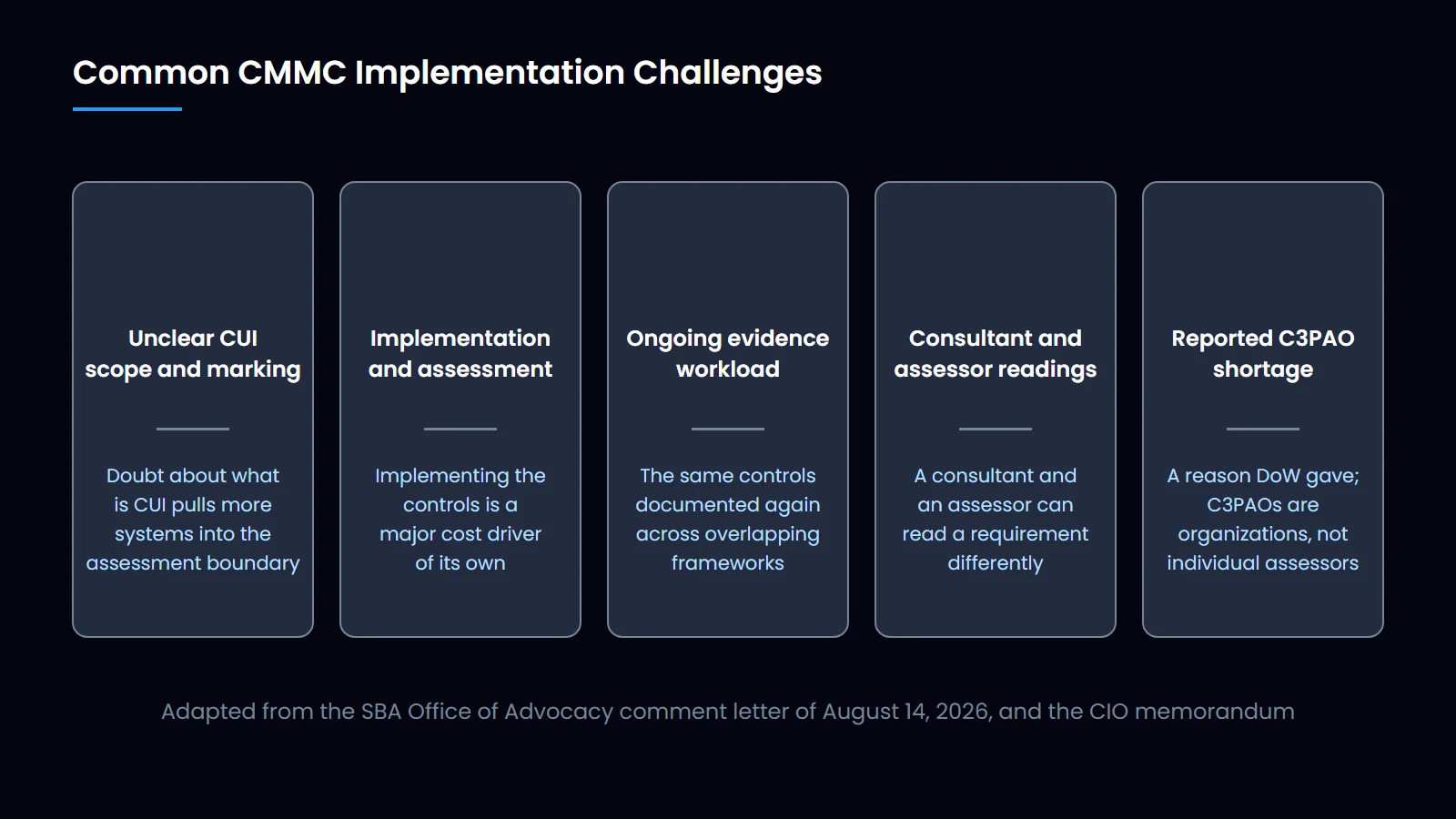
The challenges below are selected from the SBA Office of Advocacy's comment letter of August 14, 2026, which draws on a July 30 roundtable with more than 600 attendees. In that letter, uncertainty about what counts as CUI is the most frequently cited concern. The last, assessor capacity, is also one of the reasons DoW gave for the suspension.
Unclear CUI Scope and Marking
The problem is uncertainty about where CUI enters and flows, and which systems belong inside the assessment boundary. Small businesses told Advocacy that CUI is also overmarked, inconsistently marked, or improperly flowed down.
What breaks: a contractor that cannot tell which information is CUI tends to bring all of it inside the boundary, the letter adds.
What to check: before you set the boundary, agree on the CUI categories and the transfer paths with the contracting officer or the prime.
The Cost of CMMC Implementation and Assessment
The letter separates two costs: implementing the NIST SP 800-171 controls and paying for assessors. It calls implementation a major cost driver for small businesses. One small business reported $30,000 a year for a governance, risk, and compliance (GRC) platform.
Two published estimates measure different things: the SBA news release estimated total compliance costs of up to about $593,800 per CMMC certification for a small firm that needs a third-party assessment. DoD's 2024 program rule estimated $101,752 for a small entity's Level 2 certification assessment and initial affirmation, assuming the NIST SP 800-171 controls are already in place.
When the suspension was announced, SBA Administrator Kelly Loeffler said in that release:
“[C]ybersecurity cannot come at the cost of bureaucracy that shuts out the very companies our warfighters depend on.”
Kelly Loeffler, Administrator, U.S. Small Business Administration, July 13, 2026
What breaks: a budget built on DoD's assessment estimate alone can miss the cost of implementing the controls. What to check: whether a budget covers implementation, the assessment, or both. Want to see what drives the cost for your own scope? Read our guide to CMMC certification costs.
The Ongoing Documentation and Evidence Workload
Small businesses told Advocacy they document the same controls again and again across overlapping frameworks and keep extensive evidence packages. They also update their policies, system security plans, and POA&Ms whenever requirements or interpretations change.
What breaks: in small companies, that work often falls to people who would otherwise design products, serve customers, or perform the contract.
What to check: record where each piece of evidence lives and who updates it after a system change.
Inconsistent Interpretations Between Consultants and Assessors
The C3PAO that assesses you can read a requirement differently from the consultant who prepared you.
What breaks: roundtable participants reported businesses that paid one provider to prepare for an assessment and then received an entirely different interpretation from the C3PAO that conducted it.
What to check: record a disputed interpretation and its basis in writing before the assessment.
Reported Shortage of C3PAO Assessors
In July 2026, The Cyber AB, the accreditation body, counted 110 authorized C3PAOs. That figure counts assessment organizations, not individual assessors or open assessment dates.
What breaks: the SBA letter says assessor scarcity contributes to the high cost of C3PAO assessments, which dozens of small businesses reported can be prohibitively expensive.
What to check: if you need an assessment, confirm the nearest available date and the rescheduling terms with the C3PAO you choose.
Sources
- Under Secretary of War for Acquisition and Sustainment, Implementing Department of War Chief Information Officer's Suspension of the Advancement to Cybersecurity Maturity Model Certification Phase 2 Requirements, memorandum with Attachment 1, July 13, 2026. https://dowcio.war.gov/Portals/0/Documents/Library/ImplementingSuspensionCMMC-PhaseII.pdf
- eCFR, 48 CFR subpart 204.75, Cybersecurity Maturity Model Certification. https://www.ecfr.gov/current/title-48/chapter-2/subchapter-A/part-204/subpart-204.75
- Acquisition.gov, DFARS 252.204-7021, Contractor Compliance with the Cybersecurity Maturity Model Certification Level Requirements. https://www.acquisition.gov/dfars/252.204-7021-contractor-compliance-cybersecurity-maturity-model-certification-level-requirements.
- eCFR, 32 CFR 170.23, Application to subcontractors. https://www.ecfr.gov/current/title-32/subtitle-A/chapter-I/subchapter-G/part-170/subpart-D/section-170.23
- eCFR, 32 CFR 170.3, Applicability. https://www.ecfr.gov/current/title-32/subtitle-A/chapter-I/subchapter-G/part-170/subpart-A/section-170.3
- Department of War Chief Information Officer, Removing Barriers to Defense Industrial Base Expansion: Immediate Suspension and Strategic Review of Cybersecurity Maturity Model Certification Requirements, memorandum, July 2026. https://dowcio.war.gov/Portals/0/Documents/Library/CMMC-ReformMemo.pdf
- Department of War, Forging the Arsenal of Freedom: Department of War Suspends CMMC Phase II Requirements, news release, July 13, 2026. https://www.war.gov/News/Releases/Release/Article/4542329/forging-the-arsenal-of-freedom-department-of-war-suspends-cmmc-phase-ii-require/
- Department of War Chief Information Officer, Cybersecurity Maturity Model Certification program page. https://dowcio.war.gov/CMMC/
- Department of Defense, Defense Federal Acquisition Regulation Supplement: Assessing Contractor Implementation of Cybersecurity Requirements (DFARS Case 2019-D041), final rule, 90 FR 43560, Federal Register, September 10, 2025. https://www.federalregister.gov/documents/2025/09/10/2025-17359/defense-federal-acquisition-regulation-supplement-assessing-contractor-implementation-of
- Department of War Chief Information Officer, About CMMC. https://dowcio.war.gov/CMMC/About/
- Defense Pricing, Contracting, and Acquisition Policy, Class Deviation 2026-O0025, Revision 3, Revolutionary FAR Overhaul Part 40, DFARS Part 240, September 3, 2026, listed in the official DFARS overhaul class deviations index (https://www.acq.osd.mil/dpap/dars/dfars_far_overhaul_class_deviations.html). https://www.acq.osd.mil/dpap/dars/classdev/DFARS_RFO/Part-240/2026-O0025_Rev3_TAB_A_Deviation_Memo.pdf
- Department of War Chief Information Officer, CMMC Frequently Asked Questions, July 2026. https://dowcio.war.gov/Portals/0/Documents/CMMC/FAQsv6.pdf
- eCFR, 32 CFR 170.21, Plan of Action and Milestones requirements. https://www.ecfr.gov/current/title-32/subtitle-A/chapter-I/subchapter-G/part-170/subpart-D/section-170.21
- U.S. Small Business Administration, Office of Advocacy, comment letter on Reforming CMMC and Reducing Compliance Burden for the Defense Industrial Base, August 14, 2026. https://advocacy.sba.gov/wp-content/uploads/2026/08/Comment-Letter-Reforming-CMMC-and-Reducing-Compliance-Burden-081426.pdf
- Department of Defense, Cybersecurity Maturity Model Certification (CMMC) Program, final rule, 89 FR 83092, Federal Register, October 15, 2024. https://www.federalregister.gov/documents/2024/10/15/2024-22905/cybersecurity-maturity-model-certification-cmmc-program
- The White House, Executive Order 14347, Restoring the United States Department of War, September 5, 2025. https://www.whitehouse.gov/presidential-actions/2025/09/restoring-the-united-states-department-of-war/
- eCFR, 32 CFR 170.24, CMMC Scoring Methodology. https://www.ecfr.gov/current/title-32/subtitle-A/chapter-I/subchapter-G/part-170/subpart-D/section-170.24
- U.S. Department of Justice, Office of Public Affairs, Defense and Aerospace Contractors ILC Dover and ILC Astrospace Agree to Pay $13M to Resolve Cybersecurity Fraud Allegations, press release, November 3, 2026. https://www.justice.gov/opa/pr/defense-and-aerospace-contractors-ilc-dover-and-ilc-astrospace-agree-pay-13m-resolve
- Acquisition.gov, DFARS 252.204-7012, Safeguarding Covered Defense Information and Cyber Incident Reporting. https://www.acquisition.gov/dfars/252.204-7012-safeguarding-covered-defense-information-and-cyber-incident-reporting.
- Department of Defense, Class Deviation 2026-O0025 (original version, signed December 18, 2025, effective February 1, 2026; superseded by later revisions, the latest Revision 3), Revolutionary FAR Overhaul Part 40, DFARS Part 240. https://www.acquisition.gov/sites/default/files/page_file_uploads/DoD_RFO_Deviation_Part-40.pdf
- The Cyber AB, Statement on the Department of War's Suspension of CMMC Phase II Requirements, July 2026. https://cyberab.org/News-Events/Press-Releases/statement-on-the-department-of-wars-suspension-of-cmmc-phase-ii-requirements
- Federal Register, document search for Cybersecurity Maturity Model Certification. https://www.federalregister.gov/documents/search?conditions%5Bsearch_type_id%5D=3&conditions%5Bterm%5D=Cybersecurity+Maturity+Model+Certification
- Regulatory Information Service Center, Introduction to the Unified Agenda of Federal Regulatory and Deregulatory Actions-2026, Federal Register, August 14, 2026. https://www.govinfo.gov/content/pkg/FR-2026-08-14/html/2026-16603.htm
- eCFR, 32 CFR 170.17, CMMC Level 2 certification assessment and affirmation requirements. https://www.ecfr.gov/current/title-32/subtitle-A/chapter-I/subchapter-G/part-170/subpart-D/section-170.17
- Crowell & Moring LLP, Finally, the CMMC Final Rule: DoD Completes CMMC Rulemaking, Ushering in New Era in DoD Cybersecurity, client alert. https://www.crowell.com/en/insights/client-alerts/finally-the-cmmc-final-rule-dod-completes-cmmc-rulemaking-ushering-in-new-era-in-dod-cybersecurity
- eCFR, 32 CFR 170.22, Affirmation. https://www.ecfr.gov/current/title-32/subtitle-A/chapter-I/subchapter-G/part-170/subpart-D/section-170.22
- National Institute of Standards and Technology, SP 800-171 Revision 2, Protecting Controlled Unclassified Information in Nonfederal Systems and Organizations, February 2020. https://nvlpubs.nist.gov/nistpubs/SpecialPublications/NIST.SP.800-171r2.pdf
- Department of War Chief Information Officer, Brilliant at the Basics. https://dowcio.war.gov/BrilliantBasics/
- U.S. Small Business Administration, SBA Commends U.S. Department of War's Suspension of CMMC Phase II for Small Defense Contractors, news release 26-73, July 13, 2026. https://legacy.sba.gov/article/2026/07/13/sba-commends-us-department-wars-suspension-cmmc-phase-ii-small-defense-contractors
- eCFR, 32 CFR 170.4, Acronyms and definitions. https://www.ecfr.gov/current/title-32/subtitle-A/chapter-I/subchapter-G/part-170/subpart-A/section-170.4








FAQ
What is the CMMC status date?

Under 32 CFR 170.4, the CMMC Status Date is the date assessment results for the status are submitted to SPRS or the CMMC instance of the Enterprise Mission Assurance Support Service (eMASS), as applicable. Use it to calculate when your status expires: a Final Level 2 (Self) status, for example, stays current for up to three years from that date, with an annual affirmation. If a conditional status becomes final after a successful closeout, the original conditional status date remains the CMMC Status Date.
Does CMMC apply to subcontractors?
Yes, at every tier where subcontractors handle FCI or CUI on their own systems for the contract. Under 32 CFR 170.23, a subcontractor that handles only FCI needs Level 1 (Self), and one that handles CUI needs at least Level 2 (Self). A subcontractor handling CUI needs at least Level 2 (C3PAO) when the prime contract requires a C3PAO or DIBCAC assessment. Prime contractors must require their subcontractors to comply and to flow these requirements down.
When is CMMC required for DoD contracts?
Already, wherever a solicitation or contract includes the requirement: Phase 1 began on November 10, 2025, when the DFARS acquisition rule took effect. Under the July 2026 acquisition memorandum, buying offices can designate only Level 1 (Self) or Level 2 (Self) during the suspension. Level 2 (C3PAO) and Level 3 (DIBCAC) designations are suspended, and the CIO's CMMC page gives no restart date.
What CMMC level do I need?
The information you will handle sets the level, and the solicitation or contract names it in provision 252.204-7025 or clause 252.204-7021. Under 32 CFR part 170, handling only FCI calls for Level 1 (Self) and handling CUI calls for at least Level 2; DoD can also require a C3PAO assessment or Level 3 for CUI, designations that are suspended for now.
How many controls are in CMMC Level 2?
CMMC Level 2 has 110 security requirements, the requirements of NIST SP 800-171 Revision 2. Level 1 has 15, from FAR 52.204-21, and under 32 CFR 170.4 Level 3 adds 24 selected from NIST SP 800-172.
What happens if your CMMC status lapses during a contract?
Clause 252.204-7021 requires you to keep a current CMMC status at the required level or higher for the life of the contract. It also limits FCI and CUI to systems that have that status. Under the DFARS acquisition rule, the contracting officer checks SPRS before exercising an option or extending the period of performance, and does not proceed without that status for each applicable system.
About the author

Ron Gupta
—
Senior Director: Governance, Risk and Compliance
Getting his start in tech as an analyst and founder at Via Digital ID, Ron brings to the table a unique approach to cyber security. With over a decade of experience in GRC, Ron has developed and honed a skillset rich in combined audit and assessment as well as risk management and mitigation.
Ron’s ability to convey critical information, results and plans of action to executive leadership is a key skill that allows him to propel the clients he engages with to success. Ron is adept at taking target frameworks, implementing them within environments while reducing overall risk to organizations.